
Sold by: ProvenCloud
Deployed on AWS
Free Trial
This is a repackaged open source software product wherein additional charges apply for a secure, ready-to-use code-server 4.143.1 browser IDE. Code from any computer in a browser tab with a full editor, terminal and extensions, while your builds and containers run on a cloud machine. Every instance gets its own passwords.
Overview
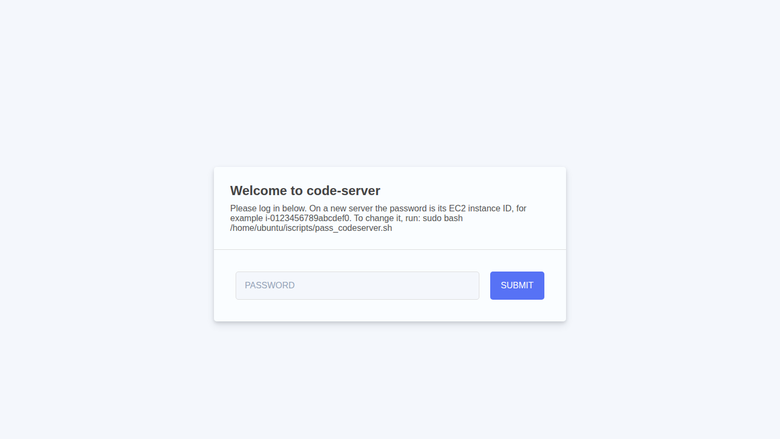
Your code editor in the browser, running in the cloud
code-server runs Code, the popular open source code editor, on a server and serves it to your web browser. You get the same editing experience, terminal, Git tools and extensions you know from the desktop, while the code, builds and containers run on a cloud machine you control. Teams use it for development from any laptop or tablet, for consistent shared environments, and to work close to their AWS resources. This image gives you a ready development server in minutes.
Who it is for
- Developers who want a powerful cloud dev box from any computer
- Teams standardising development environments
- Trainers and students who need a ready coding environment
What is included
- code-server 4.143.1 (Code 1.143.1) on Ubuntu 24.04 LTS
- Node.js 24 LTS, Python 3.12, Git, GitHub CLI and AWS CLI v2
- Docker 29 with Compose and common build tools
- nginx serving the editor over HTTPS
- Extensions from the Open VSX registry and a ready workspace at /home/ubuntu/workspace
- Webmin 2.670 for server administration
Secure by default
- No password ships in the image: every instance creates its own code-server and Webmin passwords, HTTPS certificate and server keys on first boot
- code-server and Webmin listen only on the server itself, behind nginx
- SSH accepts key-based login only, and set_domain.sh switches to your own domain with a trusted certificate
Get started in 4 steps
- Launch the instance (t3.medium recommended) and allow ports 22, 80 and 443; limit 22 to your own IP
- Allow up to 15 minutes for first boot, then run sudo pc-credentials show over SSH to see your passwords
- Open https:/// and sign in with the code-server password
- Clone your repository into /home/ubuntu/workspace and start coding
Example use case
A team of 5 developers at a consultancy uses one cloud dev box per project instead of setting up laptops. Each developer opens the editor in a browser, clones the client repository into the workspace, runs the app and its database in Docker Compose on the server, and deploys to the client's AWS account with the AWS CLI, all from a laptop or a tablet.
About ProvenCloud
ProvenCloud builds and maintains 50 ready-to-use server images on AWS Marketplace. Every image is built from official sources, scanned by AWS Marketplace before each release, and rebuilt when an important security fix ships: in November 2026 we rebuilt and re-released 29 products for CVE-2026-111497. Our Zabbix solution has passed the AWS Foundational Technical Review.
What you get from ProvenCloud on top of the free software
A pre-built and tested image that is ready in minutes, a unique security setup for every server, simple scripts for changing passwords and taking backups, regular image updates, and help by email whenever you need it. code-server is open source software licensed under MIT. code-server is a trademark of its respective owner. This image is an independent build by ProvenCloud.
Highlights
- Code from anywhere: a full browser editor based on Code 1.143.1 with an integrated terminal, Git, debugging and extensions from Open VSX. Open the instance's address over HTTPS and start working.
- Ready-made toolchain: Node.js 24 LTS, Python 3.12 with virtual environments, Git, GitHub CLI, AWS CLI v2, Docker with Compose and build tools are installed, so you can build and run projects right away.
- Secure by default: HTTPS from the first boot, a random password created for every instance, SSH with keys only, and the Webmin admin panel kept off the internet and reached through an SSH tunnel.
Details
Sold by
Categories
Delivery method
Delivery option
64-bit (x86) Amazon Machine Image (AMI)
Latest version
Operating system
Ubuntu 24.04
Deployed on AWS
Features and programs
Financing for AWS Marketplace purchases
AWS Marketplace now accepts line of credit payments through the PNC Vendor Finance program. This program is available to select AWS customers in the US, excluding NV, NC, ND, TN, & VT.

Pricing
Free trial
Try this product free for 5 days according to the free trial terms set by the vendor. Usage-based pricing is in effect for usage beyond the free trial terms. Your free trial gets automatically converted to a paid subscription when the trial ends, but may be canceled any time before that.
Pricing is based on actual usage, with charges varying according to how much you consume. Subscriptions have no end date and may be canceled any time. Alternatively, you can pay upfront for a contract, which typically covers your anticipated usage for the contract duration. Any usage beyond contract will incur additional usage-based costs.
Additional AWS infrastructure costs may apply. Use the AWS Pricing Calculator to estimate your infrastructure costs.
- ...
Dimension | Cost/hour |
|---|---|
t3.medium Recommended | $0.03 |
c1.xlarge | $0.05 |
c3.2xlarge | $0.08 |
c3.4xlarge | $0.08 |
c3.8xlarge | $0.08 |
c3.large | $0.03 |
c3.xlarge | $0.05 |
c4.2xlarge | $0.08 |
c4.4xlarge | $0.08 |
c4.8xlarge | $0.08 |
Dimensions summary
You pay an hourly software charge based on the EC2 instance type you launch. Each dimension maps to one instance type, so pricing scales with the compute family and size you choose. Smaller sizes carry a lower hourly rate, and larger sizes cost more. The software charge is separate from your own EC2 compute and storage costs, which AWS bills directly. A free trial period applies before hourly charges begin. Choose the instance type that matches your workload; billing follows that selection on a per-hour basis.
Top-of-mind questions for buyers
Each dimension maps to one EC2 instance type, charged per running hour. The hourly rate covers the software only. It does not include your EC2 compute or the 30 GiB gp3 root volume, which AWS bills separately on your usual cloud bill.
The hourly software charge meters running time on the chosen instance type. A stopped instance does not run, so the software charge stops. You may still pay AWS for attached storage while the instance is stopped, billed directly by AWS.
Billing is pay-as-you-go by the hour, with no upfront commitment. You pick an instance type and pay the matching software charge only for the hours it runs. Launched images keep running with no separate contract, since the software is open source and needs no licence key.
www.provencloud.io+1
Helpful?
Vendor refund policy
Software charges are billed hourly, only while your instance runs. You can stop charges at any time by terminating the instance or cancelling your subscription. Charges already incurred are not refundable.

Legal
Vendor terms and conditions
Upon subscribing to this product, you must acknowledge and agree to the terms and conditions outlined in the vendor's End User License Agreement (EULA) .
Content disclaimer
Vendors are responsible for their product descriptions and other product content. AWS does not warrant that vendors' product descriptions or other product content are accurate, complete, reliable, current, or error-free.
Delivery details
64-bit (x86) Amazon Machine Image (AMI)
Amazon Machine Image (AMI)
An AMI is a virtual image that provides the information required to launch an instance. Amazon EC2 (Elastic Compute Cloud) instances are virtual servers on which you can run your applications and workloads, offering varying combinations of CPU, memory, storage, and networking resources. You can launch as many instances from as many different AMIs as you need.
Version release notes
Latest stable release on AWS Marketplace.
code-server 4.143.1 (Code 1.143.1) on Ubuntu 24.04 LTS with Node.js 24.22 LTS, Python 3.12, Docker 29.9, GitHub CLI 2.103, AWS CLI 2.38, nginx (HTTPS) and Webmin 2.670.
Random code-server and Webmin passwords, HTTPS certificate and server keys are created for every instance on first boot; read them with sudo pc-credentials show.
Includes helper scripts in /home/ubuntu/iscripts for changing passwords, and pc-backup for same-server backups.
Additional details
Usage instructions
Once the instance is running, wait for the instance health checks to pass, then allow up to 15 minutes for the first-boot setup to finish. Connect over SSH with your key pair: ssh -i /path/to/key.pem ubuntu@<instance-public-ip>, then run sudo pc-credentials show to see the random passwords created for this instance. They are not your instance ID, and no two instances share them.
Open https://<instance-public-ip>/ in your browser and accept the one-time warning for the server's self-signed certificate. code-server asks only for a password: use the one labelled codeserver. Your projects folder is /home/ubuntu/workspace, and the built-in terminal runs as the ubuntu user with sudo. Extensions install from Open VSX.
Required inbound ports: 22 (SSH), 80 and 443 (the application; port 80 redirects to HTTPS). For security, allow port 22 only from your own IP address. Keep every other port closed.
Change your passwords after the first sign-in: connect over SSH and run sudo bash /home/ubuntu/iscripts/pass_codeserver.sh for code-server or pass_webmin.sh for Webmin, from the same folder. To check the server, run sudo bash /home/ubuntu/iscripts/codeserver_status.sh.
Webmin is not open to the internet. To use it, keep this SSH tunnel open on your own computer: ssh -i /path/to/key.pem -N -L 18000:127.0.0.1:8000 ubuntu@<instance-public-ip>, then open http://localhost:18000/ and sign in with admin as username and the password labelled webmin.
To use your own domain, point its DNS A record at the instance, keep port 80 open and run sudo bash /home/ubuntu/iscripts/set_domain.sh. Some editor features, such as Markdown preview, work fully only with a trusted certificate.
To back up the application on the same server, run sudo pc-backup create /var/backups/application.tar.gz and copy the file to encrypted storage outside the instance, because it contains passwords. To restore it, run sudo pc-backup restore /var/backups/application.tar.gz --confirm-restore. The backup covers the workspace, editor settings and extensions.
After a stop and start the instance gets a new public IP unless you attach an Elastic IP; your data and passwords are kept. For production, point your own domain at the instance and replace the self-signed certificate with a trusted one.
Resources
Vendor resources
Support
Vendor support
Email: support@provencloud.io
Support page: https://www.provencloud.io/support
Response time: we reply to every support email within 1 business day.
Hours: Monday to Friday, 10:00 to 19:00 IST (UTC+05:30)
Help with: first sign-in, passwords, domains and HTTPS, configuration questions, and upgrading to new versions.
Billing and refunds for this subscription are handled by AWS Marketplace.
AWS infrastructure support
AWS Support is a one-on-one, fast-response support channel that is staffed 24x7x365 with experienced and technical support engineers. The service helps customers of all sizes and technical abilities to successfully utilize the products and features provided by Amazon Web Services.
Similar products

This is a repackaged open source software product wherein additional charges apply for a secure, ready-to-use ownCloud 10.16 file sync and share server. Store, sync and share files with your team from desktop and mobile apps about 3 minutes after launch, on a server you control. Every instance gets its own passwords.

This is a repackaged open source software product wherein additional charges apply for a secure, ready-to-use SonarQube Community Build 26.11 code quality server with PostgreSQL. Scan every build for bugs, security weak spots and duplicated code, with quality gates and dashboards ready about 3 minutes after launch. Every instance gets its own passwords.

This is a repackaged open source software product wherein additional charges apply for a secure, ready-to-use Linux desktop in your web browser. Work on a full Linux desktop from any computer in a browser tab, close to your AWS resources, with no remote desktop client to install. Every instance gets its own passwords.

This is a repackaged open source software product wherein additional charges apply for a secure, ready-to-use SuiteCRM 8.10 CRM server. Track leads, deals, quotes and support cases in one CRM about 3 minutes after launch, with no per-user fees. Every instance gets its own passwords.
Customer reviews
No customer reviews yet
Be the first to review this product . We've partnered with PeerSpot to gather customer feedback. You can share your experience by writing or recording a review, or scheduling a call with a PeerSpot analyst.