Sold by: Vesoft
An enterprise graph data and intelligence platform for building graph-powered applications, large-scale graph analytics, and AI solutions.
5
Overview
Image
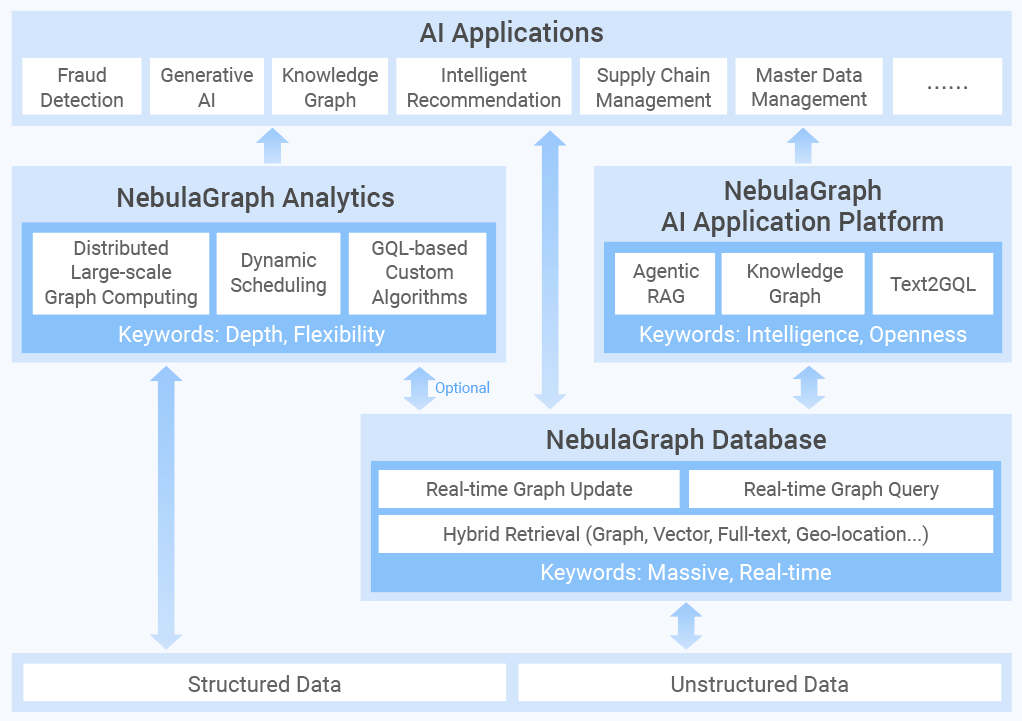
NebulaGraph Enterprise Product Architecture

Video
Product video
NebulaGraph Enterprise is an enterprise graph data and intelligence platform designed to help organizations build, analyze, and operationalize connected data at scale. It brings together graph database capabilities, large-scale graph analytics, and AI-ready graph technologies to support graph-powered applications across data, analytics, and AI workloads.
NebulaGraph Enterprise provides a high-performance distributed graph database for storing and querying large-scale connected data. Its distributed architecture supports complex relationships, multi-hop traversal, pattern discovery, and low-latency graph queries for demanding production workloads. Native GQL support and flexible graph data modeling enable developers and data teams to build applications around relationships and connected data.
NebulaGraph Analytics is a standalone enterprise graph analytics platform that can work independently of NebulaGraph Database. It is designed for large-scale graph datasets and computationally intensive workloads, enabling organizations to run graph algorithms and analytical jobs without first moving all of their data into a graph database.
NebulaGraph Enterprise provides a graph-native foundation for AI applications, knowledge graphs, and GraphRAG. NebulaGraph AI Application Platform natively integrates a high-performance vector search, empowering enterprises to build intelligent systems with deep relationship understanding. It leverages Fusion GraphRAG to deliver precise, context-aware answers, enabling seamless scaling from prototypes to production while unifying fragmented data and AI workflows.
NebulaGraph Enterprise is designed for enterprise deployment with capabilities for high availability, scalable architecture, role-based access control, monitoring, visualization, data management, and production operations. Organizations can use NebulaGraph Enterprise to establish a unified foundation for graph databases, graph analytics, and AI applications while adopting the components that best fit their workload and infrastructure requirements.
Highlights
- High-performance distributed graph database for large-scale connected data, real-time graph queries, complex relationship traversal, and mission-critical enterprise workloads.
- Large-scale graph computing for complex analytical workloads, with built-in and custom graph algorithms and flexible data access that can analyze data from existing enterprise data platforms without requiring all data to be migrated into a graph database.
- Build knowledge graphs, GraphRAG, recommendation, fraud detection, and other AI applications with rich graph data modeling, graph algorithms, and relationship-aware retrieval.
Details
Sold by
Delivery method
Deployed on AWS
New
Introducing multi-product solutions
You can now purchase comprehensive solutions tailored to use cases and industries.
Features and programs
Financing for AWS Marketplace purchases
AWS Marketplace now accepts line of credit payments through the PNC Vendor Finance program. This program is available to select AWS customers in the US, excluding NV, NC, ND, TN, & VT.

Pricing
Pricing is based on the duration and terms of your contract with the vendor. This entitles you to a specified quantity of use for the contract duration. If you choose not to renew or replace your contract before it ends, access to these entitlements will expire.
Additional AWS infrastructure costs may apply. Use the AWS Pricing Calculator to estimate your infrastructure costs.
Dimension | Description | Cost/month |
|---|---|---|
Storage node | The quota for one storage node | $4,000.00 |
Query node | The quota for one query node | $2,000.00 |
Dimensions summary
NebulaGraph Enterprise uses a contract model with two separate quota dimensions you buy in units. One dimension covers storage nodes, which hold your graph data. The other covers query nodes, which process your queries. This reflects the product's storage-and-compute separation, so you scale each part on its own. You add storage node units when your data grows and query node units when query demand rises. Each unit represents the quota for one node, so total cost depends on how many units of each type you commit to over the contract term.
Top-of-mind questions for buyers
A storage node holds your graph data on disk. A query node processes queries against that data. This product separates storage from compute, so each type runs on its own node. You buy quota in units, and each unit represents the quota for one node of that type.
Add storage node units when your graph data volume grows, since storage nodes hold the data. Add query node units when query demand or concurrency rises, since query nodes process traffic. Both charges apply independently and appear on the same contract. The two scale separately because storage and compute are decoupled.
Yes. The product supports online scaling, letting you add nodes and rebalance data without downtime. Replica counts can also be increased while running. You commit to quota units per node type over your contract term, so plan your storage and query node units around your expected production needs.
nebula-graph.io+1
Helpful?
Vendor refund policy
Please contact our professional sales within 48 hours of purchase to request a refund: https://www.nebula-graph.io/contact

Legal
Vendor terms and conditions
Upon subscribing to this product, you must acknowledge and agree to the terms and conditions outlined in the vendor's End User License Agreement (EULA) .
Content disclaimer
Vendors are responsible for their product descriptions and other product content. AWS does not warrant that vendors' product descriptions or other product content are accurate, complete, reliable, current, or error-free.
Delivery details
Software as a Service (SaaS)
SaaS delivers cloud-based software applications directly to customers over the internet. You can access these applications through a subscription model. You will pay recurring monthly usage fees through your AWS bill, while AWS handles deployment and infrastructure management, ensuring scalability, reliability, and seamless integration with other AWS services.
Resources
Vendor resources
Support
Vendor support
NebulaGraph Enterprise customers receive technical support from the NebulaGraph support team during the applicable service period. Standard technical support is available 5x8 for product usage, configuration, troubleshooting, and operational questions. For critical failures involving the NebulaGraph Database kernel module, 7x24 technical support is available.
For questions about product capabilities, licensing, pricing, deployment, or enterprise solutions, talk to our graph technology expert: https://nebula-graph.io/contact
Documentation and product resources are available at the NebulaGraph website and documentation portal.
AWS infrastructure support
AWS Support is a one-on-one, fast-response support channel that is staffed 24x7x365 with experienced and technical support engineers. The service helps customers of all sizes and technical abilities to successfully utilize the products and features provided by Amazon Web Services.
Updated weekly

Top
100
In Databases
Top
10
In ML Solutions, Databases, Data Analytics
Top
100
In Databases, Analytic Platforms
Sentiment is AI generated from actual customer reviews on AWS and G2
Functionality
Ease of use
Customer service
Cost effectiveness
Positive reviews
Mixed reviews
Negative reviews
AI generated from product descriptions
Distributed Graph Database Architecture
High-performance distributed graph database supporting large-scale connected data storage, complex relationship traversal, multi-hop queries, and low-latency graph operations for production workloads
Graph Query Language Support
Native GQL support with flexible graph data modeling capabilities for querying and analyzing connected data relationships
Large-Scale Graph Analytics Engine
Standalone enterprise graph analytics platform with built-in and custom graph algorithms for computationally intensive workloads, enabling analysis of data from existing enterprise platforms without requiring data migration
Vector Search and GraphRAG Integration
Native high-performance vector search integration with Fusion GraphRAG technology for building AI applications, knowledge graphs, and relationship-aware retrieval systems
Enterprise Deployment and Operations
High availability architecture with role-based access control, monitoring, visualization, data management capabilities, and production operations support for enterprise-scale deployments
Graph Database Architecture
Flexible property graph data model with support for Cypher query language and GraphQL for connected data applications
Security and Access Control
End-to-end data encryption, VPC isolation with dedicated infrastructure, role-based access control with granular database security, GDPR and CCPA compliance
High Availability and Reliability
99.95% uptime SLA with self-healing architecture, multi-AZ distributed cluster, ACID compliance, and fully managed automated backups
Automated Management and Scaling
Zero administration provisioning in minutes, on-demand scaling, automated service upgrades with no maintenance windows
Developer Tools and Visualization
Built-in graph visualization tools, monitoring capabilities, and extensible procedures for functionality enhancement
Graph Database Engine
Powered by ArangoDB graph database with native support for graph, JSON document, search, and machine learning capabilities within a unified query language
Security Features
Private endpoints, single sign-on (SSO), and audit logging for access control and compliance
High Availability and Disaster Recovery
Data replication and cloud backups across multiple regions for fault tolerance and business continuity
Managed Database Service
Fully-managed graph database-as-a-service eliminating infrastructure management overhead
Multi-Model Data Support
Integrated support for graph, document, search, and machine learning analytics within a single platform
Standard contract
No
No
Customer reviews
Gourav S.
Best for Industry 4.0
Reviewed on Nov 27, 2022
Review provided by G2
What do you like best about the product?
The ease of integration of big data with Nebula is remarkable. It easily integrates with enterprise softwares and provides graphical solutions with high latency and scale. Its the best solution for real time refresh use cases where data helps in making super fast and reliable decisions.
What do you dislike about the product?
Nothing as such. All the products are great.
What problems is the product solving and how is that benefiting you?
We have integrated Nebula with SAP and Level 3 systems in cement manufacturing plants to get data from 150+ designs inside the factory and provide reliable decision-making. The graphs generated have high latency and bring outliers to the screen without delay. It helps to have a solution that has 99.99% uptime. It easily integrates with enterprise software and provides high latency and scale visual solutions. It is the best solution for real-time refresh use cases where data helps make fast and reliable decisions.
Computer Software
Powerful Graph Database
Reviewed on Nov 27, 2022
Review provided by G2
What do you like best about the product?
Nebula Graph is easy to learn, highly scalable, and performant for large datasets.
What do you dislike about the product?
Cluster setup and management for horizontal scalability can be a little complicated.
What problems is the product solving and how is that benefiting you?
Nebula Graph helps to manage a large-scale graph database with rich support for different programming languages, which makes coding much more efficient for software engineers.