AWS Security Blog
Category: Security, Identity, & Compliance

AWS achieves Spain’s national Limited Distribution (Difusión Limitada) and NATO Restricted accreditation in the AWS Europe (Spain) Region
Spanish version » Amazon Web Services (AWS) is pleased to announce that AWS has achieved Spain’s national Limited Distribution (“Difusión Limitada”) and NATO Restricted accreditation for the AWS Europe (Spain) Region. The Difusión Limitada and NATO Restricted accreditation was granted by the Spanish Delegated Authority for the Security of Classified Information, the Secretary of State […]

Know the identity behind the role: Authorize and audit with trusted identity propagation
Today, AWS is making it easier to grant access and audit activity based on the user or workload (a non-human caller, such as an application, service, or an automated workflow) behind an AWS Identity and Access Management (IAM) role. Trusted identity propagation (TIP) carries the identity of the user or workload with each AWS request, […]

Introducing AWS WAF simplified pricing
November 25, 2026: We’ve updated this post to clarify the date customers will see changes. AWS WAF pricing is changing to make your bill easier to predict. Starting February 1, 2027, your bill will be based on three dimensions: the resources you protect, the traffic AWS WAF inspects, and the level of protection you apply […]
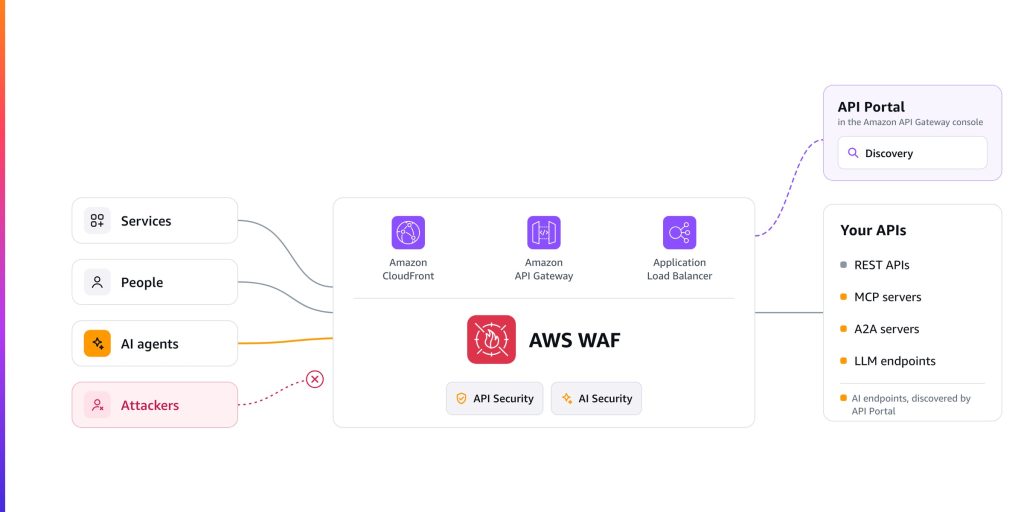
Introducing API and AI security on AWS, from discovery to protection
APIs have run digital businesses for more than a decade. For a while, there seemed to be nothing new left to say about them. That changed in 2026, when AI endpoints joined them. Teams now run large language model (LLM) inference endpoints, Model Context Protocol (MCP) servers, and Agent2Agent (A2A) servers beside their REST APIs, […]

Protect identity data with point-in-time recovery in Amazon Cognito
Amazon Cognito helps you implement secure sign-in and access control for users, microservices, and AI agents in minutes. Many of you rely on it for some of the most critical data you operate: the identities and attributes your applications use to authenticate and authorize every request. Recently, we launched point-in-time recovery (PITR) for Amazon Cognito […]

Scope down permissions of existing sessions using AWS STS GetScopedCredentials
When you build AI agents, you often want each agent or sub-agent to have only the permissions its tasks require, rather than the full permissions of the session that started it. GetScopedCredentials is a new AWS Security Token Service (AWS STS) API that you can use to scope down the permissions of existing temporary security […]

Chinese-nexus actor’s Cairn AI agents found a zero-day on their own
Amazon Threat Intelligence is sharing findings from an investigation into a Chinese-nexus threat actor using autonomous AI agents to conduct hacking operations with minimal human involvement. The actor gave the agents a simple goal: “obtain shell access.” During the campaign, the agents found a zero-day in an open-source application and used it to gain full […]

Your AWS Security, Identity, and Governance guide to re:Invent 2026
The AWS Security, Identity, and Governance team invites you to join us at re:Invent in Las Vegas from November 30 to December 4, 2026. You know all too well that AI agents now act on their own across the systems you run, and that changes what identity, detection, network protection, and governance have to cover. […]

Introducing the new AWS WAF security analytics dashboard
When blocked requests spike or a customer reports being locked out, a security team has to work out what is happening, where it is happening, and if AWS WAF is making the right call. Currently, that usually means opening each protection pack (web ACL) in turn, across domains, AWS Regions, and Amazon CloudFront distributions, or […]

How AWS Security Incident Response triages your security findings
AWS Security Incident Response continuously triages the threat findings from Amazon GuardDuty and AWS Security Hub CSPM, but most of that work never shows up as a case. If cases are all you look at, it’s hard to tell whether the service is working at all, and that’s the question I hear most often when […]