Migration & Modernization
Category: Technical How-to
From Structural Insight to Automated Transformation – Bridging CAST Imaging with AWS Transform Custom
This post has been co-written with the CAST team Introduction Enterprises want AI agents to work directly with the systems that run their business: placing orders, reading customer records, triggering workflows. Most of those systems were built long before agents existed, so they need to be assessed and modernized before an agent can call them […]
One Stack, Full VCF: Deploying VMware Cloud Foundation 9 on Amazon EVS with the EVS Deployment Orchestrator
Earlier this year we walked through deploying VCF 9 on Amazon Elastic VMware Service (Amazon EVS) using a phased automation workflow. Since then, we’ve improved and streamlined that automation into the EVS Deployment Orchestrator (EDO), now available in the solutions-for-amazon-evs repository. EDO is a tool that automates an end-to-end VMware Cloud Foundation (VCF) 9.x deployment […]
Accelerate refactored mainframe performance tuning with Kiro Power
Your modernized mainframe application passes functional testing but fails its performance targets. Each fix takes a developer 1–2 days of manual analysis. In this post, we show how a Kiro Power cuts the remediation to hours by identifying performance hotspots and proposing proven remediation patterns that you review and approve. You can apply the Power […]
Running parallel migration waves on AWS Transform with team isolation
Choose the right workspace and job isolation model so multiple migration teams can run concurrently without conflicts
Migrate Oracle-to-PostgreSQL Java code with AWS Transform custom
Migrating an enterprise Java application from Oracle to PostgreSQL is often described as a database project — but with tools like AWS Transform custom, most of the real work lands in the application code. A large Java or Kotlin codebase can carry thousands of Oracle-specific SQL statements, Java Database Connectivity (JDBC) type assumptions, object-relational mapping […]
Right-Size AWS Transform MGN Replication Servers
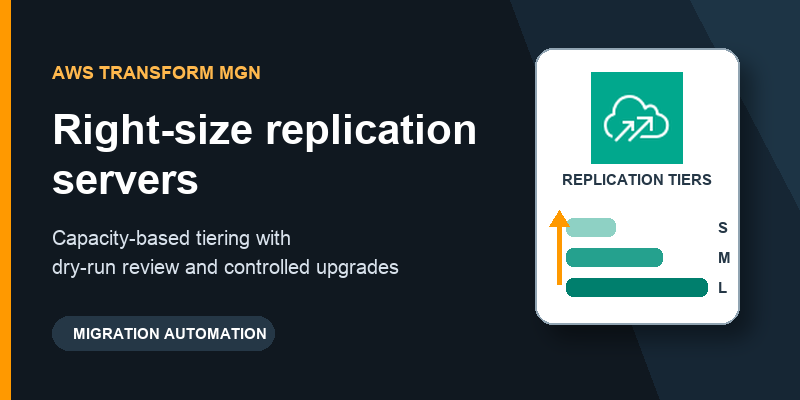
Migration teams need a consistent way to right-size AWS Transform MGN replication servers when a wave includes many source servers. The challenge grows when source servers range from small systems to workloads with several tebibytes of provisioned disk capacity. AWS Transform MGN, formerly AWS Application Migration Service, uses lightweight Amazon Elastic Compute Cloud (Amazon EC2) […]
High-throughput enterprise-scale document migration on AWS
Migrating hundreds of millions of documents to the cloud is a defining enterprise challenge – data loss, downtime, or compliance gaps break traditional approaches. Here’s how we built a system on AWS that migrated 800 million documents with configurable parallelism, self-healing, and integrity validation. When migrating at this scale, traditional approaches quickly break down. Manual […]
How resource tagging scopes the AWS Transform connector role
AccessDenied during an AWS Transform migration is often a missing or incorrect tag. This post shows you how to diagnose and resolve it.
Centralized multi-account server migration to AWS with AWS Transform
Introduction AWS Transform for migrations lets you orchestrate a centralized, multi-account migration of your workloads to Amazon EC2 from a single location. It coordinates the migration across all your target accounts and applies AI-powered automation to dependency mapping, wave planning, and network configuration, so dependent workloads move together while landing in their intended destination accounts. […]
Migrate MuleSoft APIs to AWS serverless with AWS Transform custom
When you migrate a portfolio of MuleSoft applications to AWS serverless, each application brings its own decisions: how every connector maps to an AWS service, how DataWeave scripts translate to AWS equivalents, and how error-handling strategies carry over. Multiply those decisions across a portfolio, and each migration becomes a one-off exercise. In this post, explore […]