AWS DevOps & Developer Productivity Blog
Category: Announcements
Announcing custom execution roles for AWS CloudFormation StackSets
AWS CloudFormation StackSets now supports custom execution role templates, so you can define the IAM role StackSets uses in each member account instead of the default AdministratorAccess role. Scope permissions to least privilege, and deploy service-managed stack sets that use nested stacks, macros, and transforms.
Track AWS CloudFormation StackSets deployments with progress visibility
AWS CloudFormation StackSets now adds deployment progress visibility, a stage-by-stage view of where each stack set operation stands. See how much work is complete and which accounts and stack instances need attention, and follow a deployment while it runs across tens or thousands of accounts.
What’s new in AWS Transform – continuous modernization for re:Invent 2026
Ahead of re:Invent 2026, AWS Transform continuous modernization is faster to start, easier to act on, and easier to extend. A new AWS Health integration takes you from a planned lifecycle event straight to the affected code, and remediations now arrive as one clean pull request per repository.
Restart EC2 and on-premises fleets faster with AWS CodeDeploy RESTART deployment mode
AWS CodeDeploy now offers a purpose-built RESTART deployment mode that reapplies the last successful revision to EC2 and on-premises fleets. It keeps restarts inside CodeDeploy with the same batch sizing, health checks, alarm monitoring, and rollback behavior as a standard deployment, and ran up to 6.1x faster in testing.
Announcing AWS CDK Mixins: Composable Abstractions for AWS Resources
We are excited to announce CDK Mixins, a feature of the AWS Cloud Development Kit (CDK) that fundamentally changes how you compose and reuse infrastructure abstractions. In this post, you will learn how to use CDK Mixins to apply sophisticated features to any construct – whether L1, L2, or custom – without being locked into […]

Resolve and prevent operational incidents with AWS DevOps Agent and New Relic
This post was co-written with Muthuvelan Swaminathan (Principal Partner Engineer) and Ruchika Bakolia (Software Engineer) from New Relic. Modern distributed systems that generate massive volumes of metrics, traces, and logs are inherently complex. The process of correlating logs, comparing configurations and switching between tools during incident management makes manual root cause analysis a bottleneck that […]
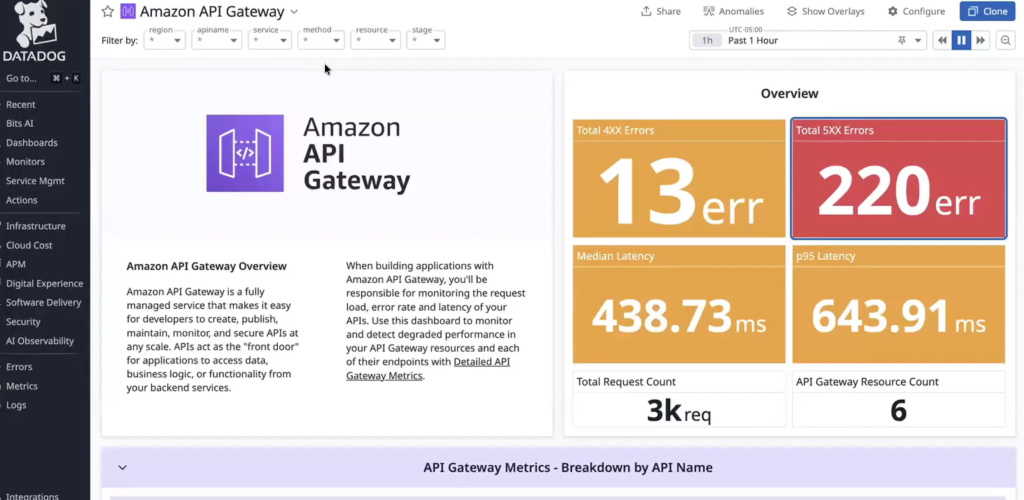
Accelerate autonomous incident resolutions using the Datadog MCP server and AWS DevOps agent (in preview)
This post was co-written with Omri Sass (Director of Product Management), Cansu Berkem (Director of Product Management), and Mohammad Jama (Product Marketing Manager) from Datadog. On-call engineers spend hours manually investigating incidents across multiple observability tools, logs, and monitoring systems. This process delays incident resolution and impacts business operations, especially when teams need to correlate […]
The Future of AWS CodeCommit
Back in July 2024, we announced plans to de-emphasize AWS CodeCommit based on adoption patterns and our assessment of customer needs. We never stopped looking at the data or listening to you, and what you’ve shown us is clear: you need an AWS-managed solution for your code repositories. Based on this feedback, CodeCommit is returning […]
Amazon introduces two benchmark datasets for evaluating AI agents’ ability on code migration
Introduction: Repository-Level Code Migration Code migration is a repository-level transformation process that modernizes entire software projects to run on new platforms, frameworks, or runtime environments while preserving their original functionality and structure. Rather than focusing on isolated files or APIs, it operates across the full repository, spanning source code, dependencies, build systems, and configuration files […]

Accelerate infrastructure development with CloudFormation pre-deployment validation and simplified troubleshooting
AWS CloudFormation makes it easy to model and provision your cloud application infrastructure as code. CloudFormation templates can be written directly in JSON or YAML, or they can be generated by tools like the AWS Cloud Development Kit (CDK). Resources are created and managed by CloudFormation as units called Stacks. Additionally, change set enable you […]