
Sold by: Spice AI
Deployed on AWS
Spice.ai Enterprise is a portable (<150MB) compute engine built in Rust for data-intensive and intelligent applications. Deployable as a container on AWS ECS, EKS, or hybrid cloud+edge, it includes Enterprise licensing, support, and SLA.
Overview
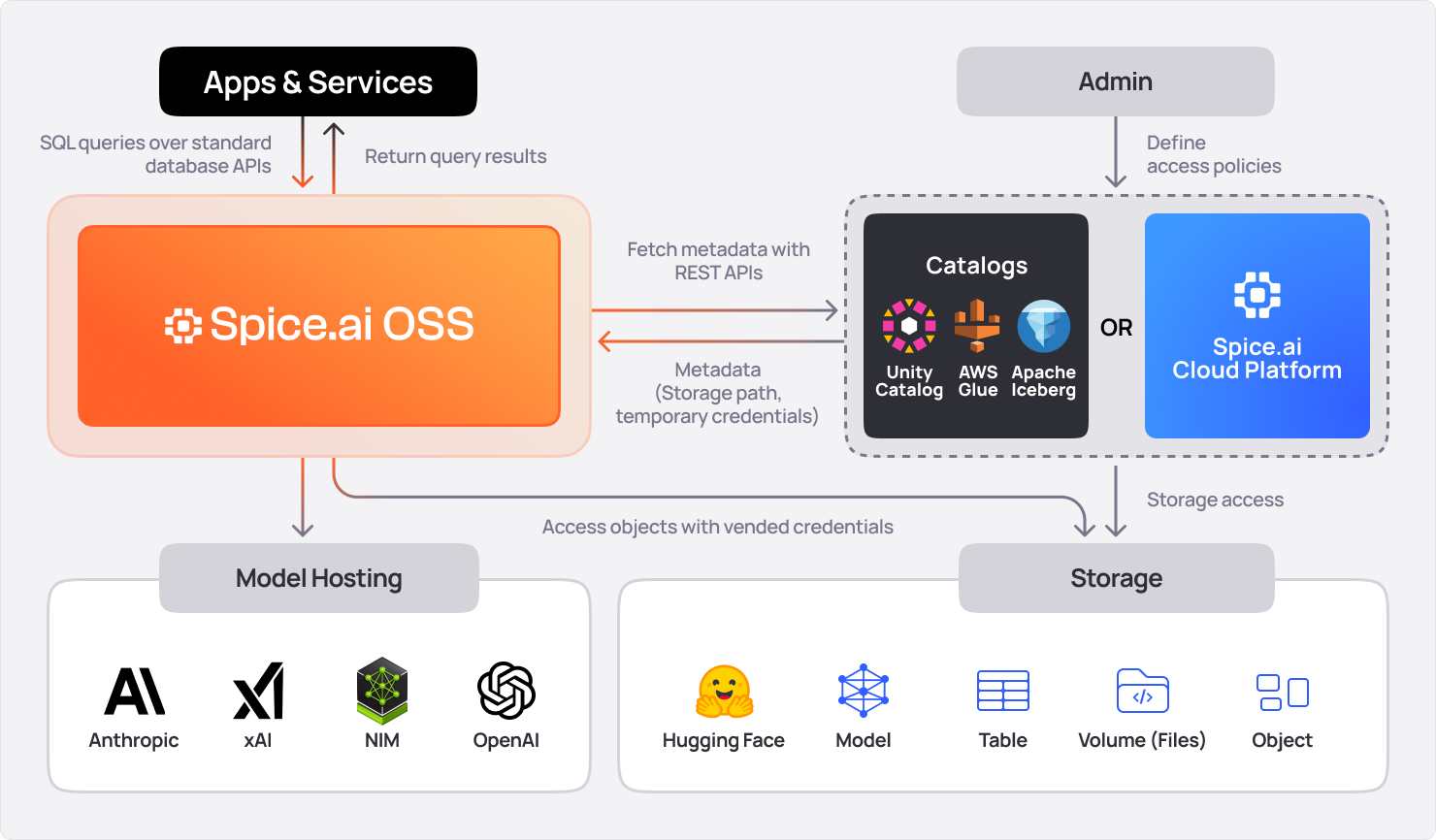
Image
Architecture

Video
Product video
Spice.ai Enterprise is a portable (<150MB) compute engine built in Rust for data-intensive and intelligent applications. It accelerates SQL queries across databases, data warehouses, and data lakes using Apache Arrow, DataFusion, DuckDB, or SQLite. Integrated and co-deployed with data-intensive applications, Spice materializes and accelerates data from object storage, ensuring sub-second query performance and resilient AI applications. Deployable as a container on AWS ECS, EKS, or hybrid cloud & edge, it includes enterprise licensing, support, and SLAs.
Note: Spice.ai Enterprise requires an existing commercial license. For details, please contact sales@spice.ai .
Highlights
- Unified data query and AI engine accelerating SQL queries across databases, data warehouses, and data lakes. Delivers sub-second query performance while grounding mission-critical AI applications with real-time context to minimize errors and hallucinations.
- Advanced AI and retrieval tools, featuring vector and hybrid search, text-to-SQL, and LLM memory, enabling data-grounded AI applications with more than 25 data connectors enabling federated queries and real-time applications.
- Deployable as a container on AWS ECS, EKS, or on-premises, with dedicated support and SLAs for scalable, secure integration into any architecture.
Details
Sold by
Delivery method
Supported services
Delivery option
Container Deployment
Helm Deployment
Latest version
Operating system
Linux
Deployed on AWS
Features and programs
Financing for AWS Marketplace purchases
AWS Marketplace now accepts line of credit payments through the PNC Vendor Finance program. This program is available to select AWS customers in the US, excluding NV, NC, ND, TN, & VT.

Pricing
Pricing and entitlements for this product are managed through an external billing relationship between you and the vendor. You activate the product by supplying a license purchased outside of AWS Marketplace, while AWS provides the infrastructure required to launch the product. AWS Subscriptions have no end date and may be canceled any time. However, the cancellation won't affect the status of the external license.
Additional AWS infrastructure costs may apply. Use the AWS Pricing Calculator to estimate your infrastructure costs.
Vendor refund policy
Refunds for Spice.ai Enterprise container subscriptions are not available after activation, as usage begins immediately upon deployment. Ensure compatibility with AWS ECS, EKS, or on-premises setups before purchase. For billing inquiries, contact AWS Marketplace support or Spice AI directly at support@spice.ai .

Legal
Vendor terms and conditions
Upon subscribing to this product, you must acknowledge and agree to the terms and conditions outlined in the vendor's End User License Agreement (EULA) .
Content disclaimer
Vendors are responsible for their product descriptions and other product content. AWS does not warrant that vendors' product descriptions or other product content are accurate, complete, reliable, current, or error-free.
Delivery details
Container Deployment
Supported services: Learn more
- Amazon ECS
- Amazon EKS
- Amazon ECS Anywhere
Container image
Containers are lightweight, portable execution environments that wrap server application software in a filesystem that includes everything it needs to run. Container applications run on supported container runtimes and orchestration services, such as Amazon Elastic Container Service (Amazon ECS) or Amazon Elastic Kubernetes Service (Amazon EKS). Both eliminate the need for you to install and operate your own container orchestration software by managing and scheduling containers on a scalable cluster of virtual machines.
Version release notes
Spice v2.4.3-enterprise is the enterprise release of v2.4.3, a security patch and hardening release. It upgrades dependencies to fix 27 security advisories. These include SSRF and denial of service in the MCP server and client, denial of service in HTTP/2, and command injection in the FTP connector. The install scripts now check the sha256 of each download before they install it. A ${ secrets:... } reference that does not resolve now fails the dataset, instead of loading it with an empty value.
The release also upgrades DataFusion to 55.3.0 and ADBC to 0.25. It fixes bugs in file and S3 datasets, HTTP caching mode, and Spicepod reload. All users should upgrade. Some datasets that loaded in v2.4.2 now fail with an error that names the cause. Before you upgrade, read Breaking Changes .
What's New in v2.4.3-enterprise
DataFusion 55.3.0
The runtime now uses DataFusion 55.3.0. The upgrade fixes these query bugs:
- Sort order with some filters. A query with a filter on a lossy cast or on wrapping arithmetic of an ORDER BY column now returns its rows in order. Before this release, the planner removed the sort for these filters.
- LEAD and LAG with IGNORE NULLS. These window functions now return the correct row.
- Sort-merge outer joins. An outer join with a filter that runs as a sort-merge join no longer fails with declared as non-nullable but contains null values.
- Other fixes. The upgrade also fixes sort-merge joins on float keys and the output order of outer joins. It fixes row counts from async UDFs, the IPC framing of spill files, and the memory accounting of grouped MIN and MAX.
With hive_partitioning_enabled: true, a __HIVE_DEFAULT_PARTITION__ directory now reads as NULL. Hive writes a NULL partition value to a directory with this name. Some file accelerations need an action after the upgrade. See Breaking Changes .
Dependency Security Updates
This release upgrades dependencies to fix 27 security advisories. The advisories affect these areas:
- MCP server and client (rmcp). SSRF in the OAuth client (RUSTSEC-2026-0457 ). Unbounded memory use in the Streamable HTTP server and clients (RUSTSEC-2026-0461 , RUSTSEC-2026-0462 ).
- HTTP/2 (h2). Denial of service through empty DATA frames (RUSTSEC-2026-0258 ).
- Compression (zstd, zstd-safe). Data from one stream in another stream, and uninitialized memory (RUSTSEC-2026-0391 , RUSTSEC-2026-0398 , RUSTSEC-2026-0403 ).
- FTP connector (suppaftp). Command injection through line breaks in control-channel arguments (RUSTSEC-2026-0271 ).
- QUIC (quinn-proto). Panics that a remote peer can cause, streams past the stream limit, and memory exhaustion from a long Retry token (RUSTSEC-2026-0338 , RUSTSEC-2026-0340 , RUSTSEC-2026-0343 , RUSTSEC-2026-0523 , RUSTSEC-2026-0524 ).
- WebAssembly (wasmtime). Type confusion, panics, and unchecked memory use between components (RUSTSEC-2026-0422 , RUSTSEC-2026-0423 , RUSTSEC-2026-0424 ).
- File parsing. Panics and unbounded allocation on malformed XLSX files (calamine, RUSTSEC-2026-0436 ). Exponential and quadratic Markdown parsing (pulldown-cmark, RUSTSEC-2026-0414 , RUSTSEC-2026-0433 ).
- Archive extraction (zip 3). Symlink and permission escapes, and a crash (RUSTSEC-2026-0367 , RUSTSEC-2026-0368 , RUSTSEC-2026-0369 , RUSTSEC-2026-0429 ). The runtime no longer depends on zip 3.
- Other. Timing side channels in crypto-bigint and ctutils (RUSTSEC-2026-0387 , RUSTSEC-2026-0385 ). Unsound AsyncFd constructors in tokio (RUSTSEC-2026-0386 ). A libz-sys build script that leaked environment variables (RUSTSEC-2026-0418 ).
Two behavior changes come with these upgrades:
- An FTP download that the server reports as failed now returns an error. Before this release, it could return truncated data.
- The MCP server returns the JSON-RPC error -32602 with HTTP 200 for an unknown tool. Before this release, it returned HTTP 400. The MCP specification requires HTTP 200.
Install Scripts Check Downloads
The install scripts now check the sha256 of each download before they extract it. This applies to install.sh, install-spiced.sh, and Install.ps1. If the sha256 does not match, the install stops and installs nothing. For a 2.4.x release, the scripts compare the download with the sha256 that GitHub recorded for the release asset. Before this release, the scripts did not check downloads.
The install scripts also have these fixes:
- Shell syntax in an install directory. install.sh, install-spiced.sh, and install-nightly.sh no longer run an install directory that contains shell syntax as a command. Before this release, SPICE_INSTALL_DIR='/tmp/x; touch /tmp/pwned' ran touch /tmp/pwned, as root when the install used sudo.
- Missing /usr/local/bin. install-spiced.sh now asks for sudo before it creates a missing install directory. Before this release, a user who was not root stopped with Permission denied. This occurred on a Mac with Apple silicon and no /usr/local/bin, for example.
- Windows PATH. Install.ps1 no longer fails when the user PATH is not set. It now compares whole PATH entries. Before this release, a similar directory such as .spice\bin2 stopped the installer from adding .spice\bin.
spice install <version> and spice upgrade --version <version> no longer fail with Release not found for a release older than the 30 newest releases. The CLI now finds the release by its tag.
The new download checks can stop some installs that worked before. See Breaking Changes .
Secret References That Do Not Resolve Fail the Dataset
A dataset or catalog with a ${ secrets:... } reference that does not resolve now fails to load. The error names the parameter and the reference, and it never shows a secret value. Before this release, the runtime replaced the reference with an empty value and loaded the dataset with that value.
This applies only to dataset and catalog params. Other datasets continue to load. When a secret store returns an error, the runtime retries the load. An empty or whitespace file_format now also fails, with an error that lists the valid formats.
If a secret is optional on purpose, define it with an empty value, such as FMT= in the environment or a .env file. A secret with an empty value counts as resolved. For details, see Secret Stores .
Buffered /v1/sql Results Stay Within the Memory Limit
A /v1/sql response that the runtime buffers now counts against runtime.query.memory_limit . A result that does not fit in the limit returns HTTP 503 with The query result is too large to buffer in memory for this response. Before this release, one request could use memory outside the limit. In a test with a 256 MiB limit, one text/plain request raised peak memory from 0.7 GB to 7.4 GB.
The runtime buffers text/plain, CSV, the vnd.* formats, JSON with union columns, and the final result of a BEGIN ... COMMIT transaction. Other JSON responses stream and do not change.
ADBC 0.25
The ADBC data connector and the ADBC catalog now use ADBC 0.25, from Apache Arrow ADBC 25 . The runtime includes the ADBC driver manager. The upgrade from ADBC 0.24 brings these changes to it:
- A broken driver fails when it loads, not at its first call. On Linux and macOS, the driver manager now resolves every symbol of a driver library when it loads the library. A driver with a missing symbol now fails to load. The dataset or catalog fails with Failed to load ADBC driver '<driver>', and the error gives the reason from the system loader. Before this release, such a driver loaded, and the process could crash at the first call into the driver.
- Query cancellation comes from upstream ADBC. ADBC 0.25 cancels a running statement without a wait for the lock that the statement holds. Spice carried the same fix as a patch in its ADBC fork through ADBC 0.24. Cancellation works as in v2.4.2. When the runtime stops reading an ADBC query, for example after a client cancels it, the runtime cancels the statement in the driver. Then it returns the connection to the pool.
- One fork patch. The Spice fork of ADBC now carries one patch. The patch limits ADBC to the Arrow major version that the runtime uses.
The runtime does not include ADBC drivers, and the upgrade does not change a driver that you install. ADBC 25 also releases new C and Go drivers, version 1.13.0. These drivers have their own fixes, for example:
- PostgreSQL driver. It binds and reads uuid values as the Arrow arrow.uuid extension type. It maps more SQLSTATE codes to ADBC errors, and it reads all results after a query. It also fixes ingestion of some negative decimal values.
- SQLite driver. It formats extreme date and time values correctly. It counts rows_affected only for statements that change rows.
For the full list, see the ADBC 25 release notes .
File and S3 Dataset Bug Fixes
This release fixes bugs in file and object-store datasets, such as S3 , when their source files change. The fixes apply to federated and accelerated datasets.
- CSV columns bind by header name. A CSV or TSV dataset with has_header: true (the default) now reads each column by its header name. Before this release, the runtime read columns by position. When a file changed its column order, values loaded under the wrong column names. A CSV with has_header: false still binds by position.
- A deleted or emptied source fails the refresh. When a refresh finds no data files for a dataset, it now fails, and the acceleration keeps its last data. The dataset status changes to Error, and the log names the dataset and path: No data files are yet available for dataset .... Before this release, a full refresh loaded zero rows into the acceleration. This covers an emptied directory or prefix, a prefix with only its folder marker, and a deleted single S3 object. A header-only CSV file or a zero-row Parquet file still loads as zero rows.
- A renamed or removed column fails the refresh. A refresh that reads every file now fails when no source file has a column of the dataset. The acceleration keeps its last data. Before this release, the refresh loaded NULL values for that column. This check covers Parquet, ORC, JSON, CSV, and TSV files. CSV and TSV files need a header row.
- JSON sources and federated queries. A missing JSON key fails the refresh only when the files also have new keys, which is the pattern of a rename. A JSON source with zero records can still clear the acceleration. A federated query returns NULL for a missing column. It logs one warning that names the dataset and the column.
- The file watcher sees more types of writes. With file_watcher: enabled, the acceleration now refreshes after an atomic replace (write a temporary file, then rename it). It also refreshes after appends that arrive close together and after a large in-place rewrite. Before this release, the watcher missed later writes after a rename. It also dropped the last write of a burst and could refresh from an empty or partial file. The watcher now watches the parent directory and waits 400 ms after the last write before it refreshes.
Other Bug Fixes
- HTTP caching mode. An HTTP dataset with refresh_mode: caching now fetches the request keys that are not in the cache. Before this release, a query that named both cached and uncached keys returned only the cached rows. This applied to an IN list or an OR of the same column on request_path, request_query, or request_body. A query that finds some of its keys in the cache also obeys max_request_partitions. A query over the limit fails with the same error as a query with no cached keys, and it sends no request.
- Views after a Spicepod reload. A view now reads the dataset that the Spicepod declares after a reload replaces that dataset, and it fails when a reload removes the dataset. Before this release, the view continued to read the old version of the dataset. This also applies to a view that reads the dataset in a subquery or through another view.
- /v1/ready after a Spicepod reload. /v1/ready no longer returns 503 for a component that a reload removed before it loaded.
- SQL parameters in search functions. A query with a parameter such as $1 in a text_search, vector_search, or rrf argument no longer fails with a placeholder error. The runtime now puts the parameter values into the arguments before it plans the query. The plan cache does not keep these plans. For the search functions, see Search .
- Refresh requests with an empty body. POST /v1/datasets/{name}/acceleration/refresh with an empty body and Content-Type: application/json no longer fails with HTTP 400. This occurred when a proxy added that header to a request with no body. An empty or whitespace body now gives the default refresh. Malformed JSON still returns 400, and an unknown refresh_mode still returns 422.
- time_column: last_modified. A dataset with time_column: last_modified no longer fails with time_column 'last_modified' was not found. Spice renamed this metadata column to _last_modified in v2.0. The runtime now uses _last_modified when the data has no last_modified column, and it logs a deprecation warning. time_format defaults to timestamptz for _last_modified.
- Delta Lake struct filters. A WHERE filter on a struct field no longer fails with Error during planning: Field a not found in struct. This applied to a federated Delta Lake dataset on a table with column mapping (delta.columnMapping.mode set to name or id).
- Maps inside struct columns. A key lookup into a map inside a struct column, such as som['mm']['k'], no longer fails on a federated Parquet file dataset. The query failed with Internal error: PhysicalExpr Column references column 'som' ....
Dependency Updates
| Dependency / Component | v2.4.2 | v2.4.3 |
|---|---|---|
| Apache DataFusion | v55.2.0 | v55.3.0 |
| ADBC | v0.24.0 | v0.25.0 |
| rmcp | v3.3.0 | v3.10.0 |
| h2 | v0.4.14 | v0.4.20 |
| zstd | v0.13.3 | v0.13.5 |
| zstd-safe | v7.2.4 | v7.4.1 |
| suppaftp | v6.3.0 | v12.2.1 |
| quinn-proto | v0.11.16 | v0.11.19 |
| wasmtime | v48.0.7 | v48.0.8 |
| calamine | v0.37.0 | v0.38.0 |
| pulldown-cmark | v0.13.4 | v0.13.6 |
| zip 3 | v3.0.0 | Removed |
| crypto-bigint | v0.5.5 | v0.7.11 |
| ctutils | v0.4.2 | v0.4.8 |
| tokio | v1.52.3 | v1.54.1 |
| libz-sys | v1.1.29 | v1.1.33 |
For the changes in DataFusion and ADBC, see DataFusion 55.3.0 and ADBC 0.25 . For the advisories that the other upgrades fix, see Dependency Security Updates .
Breaking Changes
Each breaking change in v2.4.3 is part of a security fix or a correctness fix. Most of them replace a silent fallback with an error that names the cause. Two of them change a result without an error: the HTTP status for an unknown MCP tool, and the value of a Hive default partition.
Security
Secret references that do not resolve fail the dataset. A dataset or catalog with a ${ secrets:... } reference in params that does not resolve now fails to load. It no longer loads with an empty value. Other datasets continue to load. If a secret is optional on purpose, define it with an empty value, such as FMT=. An empty file_format value also fails.
Install scripts stop on a download that they cannot check.
- An install stops when the script cannot get the expected sha256, for example when the GitHub API request fails or hits its rate limit. For a 2.4.x release, the script always sends this request, also for a pinned version such as bash -s 2.4.3. To fix it, set GITHUB_TOKEN. To install with no check, set SPICE_INSTALL_ALLOW_UNVERIFIED=1.
- An install of v1.3.1 or older stops, because GitHub recorded no sha256 for these releases. Set SPICE_INSTALL_ALLOW_UNVERIFIED=1 to install them.
- An install always stops on a sha256 mismatch. No setting changes this.
- Install.ps1 writes its output with Write-Output, not Write-Host. A failed install now throws an error. Before this release, it exited with status 0.
Large buffered /v1/sql results return HTTP 503. A CSV, text/plain, or vnd.* response from /v1/sql that does not fit in runtime.query.memory_limit now returns HTTP 503. Before this release, it returned HTTP 200 and used memory outside the limit. To get a large result over HTTP, request JSON. The runtime streams JSON when the result has no union columns.
MCP and FTP behavior after the dependency upgrades.
- The MCP server returns HTTP 200 with the JSON-RPC error -32602 for an unknown tool. Before this release, it returned HTTP 400.
- An FTP download that the server reports as failed now returns an error. Before this release, it could return truncated data.
Correctness
Hive __HIVE_DEFAULT_PARTITION__ reads as NULL. With hive_partitioning_enabled: true, rows under a col=__HIVE_DEFAULT_PARTITION__/ directory now return NULL for that partition column. Partition columns are now nullable. WHERE col IS NULL matches these rows, and WHERE col = '__HIVE_DEFAULT_PARTITION__' does not.
An existing mode: file acceleration of such a dataset fails to refresh after the upgrade. The error is Invalid batch column ... has null but schema specifies non-nullable. The dataset continues to serve its existing data. To fix it:
- With refresh_mode: full, set on_schema_change: sync_all_columns.
- With refresh_mode: append or changes, rebuild the acceleration.
Other Hive datasets continue to refresh. They log a startup warning and report the partition column as NOT NULL until you rebuild the acceleration.
File datasets fail on missing files or columns. These checks keep a refresh from replacing the data in an acceleration with an empty or NULL result.
- A refresh that finds no data files now fails, and the acceleration keeps its last data. A federated query of a dataset with no data files now returns an error that names the dataset and path. Before this release, both returned zero rows.
- A refresh that reads every file now fails when no file has a column of the dataset. Before this release, the refresh loaded NULL values.
Upgrading
To upgrade to v2.4.3-enterprise, use one of the following methods:
Docker:
Run using the 2.4.3 Docker enterprise image:
docker run --name spiceai-enterprise \ -p 50051:50051 -p 8090:8090 \ 709825985650.dkr.ecr.us-east-1.amazonaws.com/spice-ai/spiceai-enterprise-byol:2.4.3-enterprise-models --http 0.0.0.0:8090 --flight 0.0.0.0:50051For available tags, see GHCR .
Helm:
helm pull oci://709825985650.dkr.ecr.us-east-1.amazonaws.com/spice-ai/spiceai-enterprise-byol --version 2.4.3-enterprise-helmCookbook Updates
No new cookbook recipes.
The Spice Cookbook provides recipes to help you get started with Spice.
What's Changed
The v2.4.3 changelog lists every change.
Additional details
Usage instructions
The docker image expects a spicepod.yaml in the /app directory. Mount a volume into the container with the configured spicepod.yaml.
By default the endpoints only listen on 127.0.0.1, to access the endpoints from outside of the docker container, specify the endpoints to listen on 0.0.0.0 as shown below.
i.e. to mount the current directory into /app: docker run --name spiceai-enterprise -v .:/app -p 50051:50051 -p 8090:8090 709825985650.dkr.ecr.us-east-1.amazonaws.com/spice-ai/spiceai-enterprise-byol:2.4.3-enterprise-models --http 0.0.0.0:8090 --flight 0.0.0.0:50051
Resources
Vendor resources
Support
Vendor support
Spice.ai Enterprise includes 24/7 dedicated support with a dedicated Slack/Team channel, priority email and ticketing, ensuring critical issues are addressed per the Enterprise SLA.
Detailed enterprise support information is available in the Support Policy & SLA document provided at onboarding.
For general support, please email support@spice.ai .
AWS infrastructure support
AWS Support is a one-on-one, fast-response support channel that is staffed 24x7x365 with experienced and technical support engineers. The service helps customers of all sizes and technical abilities to successfully utilize the products and features provided by Amazon Web Services.
Similar products

Spice AI-provided Consulting Services to help deploy and manage Spice AI software. Consulting services are provided by in-house technical and product specialists qualified to assist customers in their Spice AI journey.

Drive insight discovery with the data visualization app that anyone can use. With Qlik Sense, everyone in your organization can easily create flexible, interactive visualizations and make meaningful decisions.

MagOneAI is an enterprise Agentic AI platform to Build, Deploy, and Govern production-grade AI agents on your own infrastructure. LLM-agnostic. No per-execution fees. ISO 42001, 27001 & 9001 certified. Trusted by 80+ enterprises.

Splunk Enterprise - Term License with Standard Success Plan - 50 GB/day, 12-month contract plan.
Customer reviews
No customer reviews yet
Be the first to review this product . We've partnered with PeerSpot to gather customer feedback. You can share your experience by writing or recording a review, or scheduling a call with a PeerSpot analyst.