Sold by: Zilliz
Deployed on AWS
Free Trial
AWS Free Tier
Milvus, the world most popular open-source vector database (42k+ GitHub stars), now offers an official fully managed service: Zilliz Cloud, built by the original Milvus team. Purpose-built for GenAI embedding workloads and trusted by 10,000+ organizations, Zilliz delivers hybrid search and sub-10 ms latency at billion-vector scale. Enjoy a monthly Free Tier (5GB storage, 2.5M vCUs) or try Serverless/Dedicated free for 30 days, cancel anytime.
4.7
Overview

Image
Zilliz Cloud architecture
Video
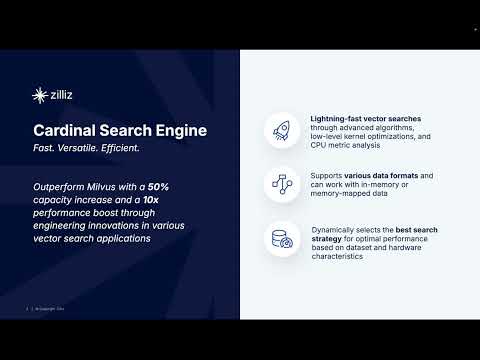
Product video
Milvus now offers an official fully managed cloud service: Zilliz Cloud, built by the original Milvus team, for vector search, semantic search, RAG, and GenAI applications. It provides high-performance vector storage and retrieval with hybrid search (vector + metadata filtering), delivering sub-10 ms latency at billion-vector scale for demanding, production environments. Learn more at: https://zilliz.com/?utm_source=awsmp&utm_medium=webpage
Zilliz Cloud is designed for teams that need to move beyond DIY deployments. With elastic, cloud-native scaling, high throughput, and high performance, users don't need to worry about operational overhead of managing infrastructure, making it easier to run Milvus reliably in production.
Built for real GenAI applications across modern AI stacks, Zilliz Cloud integrates seamlessly with popular frameworks like LangChain, LlamaIndex, and Haystack to power production workflows such as RAG pipelines, semantic search, and knowledge retrieval. It runs natively on major cloud platforms including AWS, GCP, and Azure.
Zilliz Cloud supports production use cases including reverse image and video search, recommendation systems, enterprise semantic search, agentic workflows, and anomaly detection across industries like legal tech, e-commerce, marketplaces, and SaaS. In real deployments, customers run multi-billion-vector indexes with sub-200ms visual search performance, achieve high relevance in text and image queries, and scale conversational AI and agentic services with low latency and cost efficiency.
Zilliz Cloud lowers the total cost of ownership for running Milvus at scale, combining high performance with elastic, pay-as-you-go pricing. It is available in Free, Serverless (PAYG), Dedicated Cluster (PAYG or contract), and BYOC plans. Get started with the monthly Free Tier (5 GB storage, 2.5 M vCUs, up to 5 collections), or try Serverless or Dedicated free for 30 days, cancel anytime. Full pricing details at https://zilliz.com/pricing?utm_source=awsmp&utm_medium=webpage
Highlights
- High Performance & Cost Efficiency: Up to 4x faster than open-source Milvus, with hot-warm-cold tiered storage and a cloud-native, index-optimized architecture that delivers a lower total cost than S3-based vector pipelines, with flexible pay-as-you-go pricing.
- Enterprise Scale & Trust: Built for true billion-scale production, featuring advanced multitenancy with 100K+ collections per cluster, elastic auto-scaling, a 99.95% SLA, global clusters for region-level resilience, and enterprise-grade security with BYOC deployment, SOC 2, ISO 27001, and GDPR compliance.
- Next-Gen AI Data Stack: Go beyond vector search with native hybrid vector, full-text, and metadata filtering, 4x faster full-text search than Elasticsearch, 10x faster filtering via JSON Shredding, integrated reranking, and seamless integration with next-generation multimodal data lakes and the big data ecosystem.
Details
Features and programs
Buyer guide
Gain valuable insights from real users who purchased this product, powered by PeerSpot.

Financing for AWS Marketplace purchases
AWS Marketplace now accepts line of credit payments through the PNC Vendor Finance program. This program is available to select AWS customers in the US, excluding NV, NC, ND, TN, & VT.

Pricing
Free trial
Try this product free according to the free trial terms set by the vendor.
Pricing is based on actual usage, with charges varying according to how much you consume. Subscriptions have no end date and may be canceled any time.
Additional AWS infrastructure costs may apply. Use the AWS Pricing Calculator to estimate your infrastructure costs.
Dimension | Cost/unit |
|---|---|
Zilliz Cloud Usage (Each unit is 0.1 cent of usage) | $0.001 |
Dimensions summary
This listing uses one usage-based dimension. You pay only for what you consume, with no upfront commitment. Each unit equals 0.1 cent of usage, so your bill scales directly with actual activity. Your total depends on how you run the managed vector database, including compute units for search and indexing, stored data, and data transfer. Charges accumulate as you use these resources and roll up into usage units. Because billing follows consumption, costs rise or fall with your workload rather than a fixed monthly fee.
Top-of-mind questions for buyers
A compute unit is a managed node of hardware resources that serves your indexes and search requests. Capacity per CU depends on cluster type: performance-optimized handles about 2 million 768-dimensional vectors, capacity-optimized about 8 million, and tiered-storage about 40 million. CUs are billed by the minute of active runtime.
When you suspend a cluster, vector database compute charges stop. Storage charges continue until you delete the cluster data, files in volume, and backups. No compute costs apply during Creating, Suspending, Resuming, or Suspended states. Storage has a minimum one-hour charge; backup storage has a minimum one-day charge.
Compute, storage, and data transfer all accrue at once and roll into usage units. Compute covers query and indexing runtime. Storage covers cluster data and backups, billed monthly per gigabyte. Data transfer covers cross-region or internet egress, with the first 100 GB free. Private endpoint operations avoid data transfer charges.
zilliz.com+1
Helpful?
Vendor refund policy
Zilliz Cloud does not currently offer refunds. Please refer to the Acceptable Use Policy for the refund policy. https://zilliz.com/acceptable-use-policy
Custom pricing options
Request a private offer to receive a custom quote.

Compliance
Compliance profile
This information is produced by a third-party provider from the provider's trust center data and is provided for informational purposes only.
- Source
- Vanta Trust Center

HIPAA
SOC 2 Type II

GDPR

ISO 27001:2022
Legal
Vendor terms and conditions
Upon subscribing to this product, you must acknowledge and agree to the terms and conditions outlined in the vendor's End User License Agreement (EULA) .
Content disclaimer
Vendors are responsible for their product descriptions and other product content. AWS does not warrant that vendors' product descriptions or other product content are accurate, complete, reliable, current, or error-free.
Delivery details
Software as a Service (SaaS)
SaaS delivers cloud-based software applications directly to customers over the internet. You can access these applications through a subscription model. You will pay recurring monthly usage fees through your AWS bill, while AWS handles deployment and infrastructure management, ensuring scalability, reliability, and seamless integration with other AWS services.
Resources
Vendor resources
Support
Vendor support
Have questions about purchasing Zilliz Cloud? Please review pricing details at https://zilliz.com/pricing or contact us at https://zilliz.com/contact-sales .
Zilliz support has been continuously praised by customers. Review the SLA at https://zilliz.com/sla for more details. For technical help, please contact support@zilliz.com .
AWS infrastructure support
AWS Support is a one-on-one, fast-response support channel that is staffed 24x7x365 with experienced and technical support engineers. The service helps customers of all sizes and technical abilities to successfully utilize the products and features provided by Amazon Web Services.
Updated weekly
Top
10
In Software Development
Top
10
In Embeddings
Top
10
In Embeddings, Generative AI, Databases
Sentiment is AI generated from actual customer reviews on AWS and G2
Functionality
Ease of use
Customer service
Cost effectiveness
Positive reviews
Mixed reviews
Negative reviews
AI generated from product descriptions
Vector Search Performance
Sub-10 millisecond latency at billion-vector scale with support for multi-billion-vector indexes
Hybrid Search Capabilities
Native hybrid vector search combined with full-text search and metadata filtering, including JSON Shredding for 10x faster filtering
Cloud-Native Architecture
Elastic auto-scaling, hot-warm-cold tiered storage, and cloud-native index-optimized architecture running natively on AWS, GCP, and Azure
Enterprise Security and Compliance
SOC 2, ISO 27001, and GDPR compliance with 99.95% SLA, advanced multitenancy supporting 100K+ collections per cluster, and BYOC deployment option
AI Framework Integration
Seamless integration with LangChain, LlamaIndex, and Haystack frameworks for RAG pipelines, semantic search, and knowledge retrieval workflows
Hybrid Search Capabilities
Combines vector similarity search with keyword matching and structured metadata filtering to retrieve relevant results across large-scale datasets
Multimodal Data Support
Stores and searches across text, images, and other media types with native support for multiple data formats
Pluggable Embedding and LLM Integration
Supports multiple embedding and language model providers including AWS Bedrock, AWS SageMaker, OpenAI, Cohere, Anthropic, Google, and Hugging Face with ability to swap models without re-architecting applications
Native Multi-Tenancy with Data Isolation
Provides built-in multi-tenancy support with data isolation between tenants, role-based access control (RBAC), and SOC 2 Type II certification for security and compliance
Natural Language Query Agent
Converts natural-language questions into precise database queries and returns answers with source citations for AI-powered retrieval
Hybrid Search Capabilities
Combines semantic and keyword search with integrated reranking to deliver relevant results across different query types.
Low-Latency Vector Retrieval
Achieves 20-100ms search latency on billion-vector datasets with real-time indexing and a purpose-built Rust engine.
Scalable Architecture
Supports scaling from thousands to billions of vectors using On-Demand elastic scaling or Dedicated Read Nodes for provisioned capacity.
Security and Compliance
SOC 2 Type II and HIPAA certified with security enforced at the data layer for enterprise-grade protection.
Ecosystem Integration
Provides 50+ integrations with popular AI frameworks and data platforms, including deep support for Amazon Bedrock and SageMaker.
Validated by AWS Marketplace
FedRAMP
GDPR
HIPAA
ISO/IEC 27001
PCI DSS
SOC 2 Type 2
-
-
No security profile
No security profile
Standard contract
No
No
Customer reviews
Kostas Eftaxias
Managed vector search has enabled reliable audio retrieval and reduced our infrastructure costs
Reviewed on Nov 23, 2026
Review from a verified AWS customer
What is our primary use case?
Our main use case for Zilliz Cloud is vector databases. We serve production services that perform audio retrieval.
A typical audio retrieval workflow with Zilliz Cloud starts with an audio file, from which we extract embeddings during the ingestion procedure. When we try to find this audio against a library full of audios, we search segment by segment and look for the approximate nearest neighbor. We then gather all the results together, aggregate them, and see which segments match which audio in our library.
We are now launching a vector Lakebase use case with Zilliz Cloud, where we are doing multimodal embeddings of text, audio, lyrics, and metadata, all together, in order to make more refined searches and retrieval. We also use that information for graphRAG applications, while agents get the information from the multimodal indexes and feed our agentic workflows.
How has it helped my organization?
Zilliz Cloud has impacted our organization positively, mainly in terms of scale. We have some demanding retrieval systems that have high traffic, and I have not had any hiccups in the three to four years that I have been using it. There have been no failures in production and reliability is key for us. We also get new features that drive new developments in our services, which is a really positive plus.
Before using a vector database, and Zilliz Cloud was the one that we chose, we were using OpenSearch for vector retrieval. That cost around $20K per month for serving the amount of information that we serve. This dropped to around $2,400, which is around 8 times less. In terms of cost, it was a no-brainer to go with this solution. At the same time, we could manage our throughput and meet our demands, which would not have happened if we had looked at less vector-oriented solutions.
What is most valuable?
Among the best features Zilliz Cloud offers, the flexibility and the managed service are pretty good. We have flexibility in terms of what scale we want to use for each application, and we can launch a cluster in a couple of clicks. I have not faced any downtime or any problems. We have metrics that we can send to Prometheus, Grafana, or DataDog, where we can create alerts if we have any problems. There are also automatic backups. All together, I think it is a complete solution for vector database use cases.
The flexibility and managed service of Zilliz Cloud have helped our team a lot. We did not want to invest time and staff in managing a Kubernetes cluster in-house. We are not using our own Kubernetes cluster. Instead, we have a managed Kubernetes solution that is launched for us which is a better case than maintained. I think it was the best solution, with not significant extra cost compared to the in-house solution with Milvus.
I have nothing else to add about the features of Zilliz Cloud, apart from the fact that the support from the Zilliz team has been really helpful. I am also really grateful that we have new features coming all the time. I am constantly evolving and advancing my stack, the services, and the capabilities that we have in our services, given the opportunities that the Zilliz Cloud product gives us with every major and minor release.
What needs improvement?
As Zilliz Cloud stands now, I think it is on the right path. We are looking at vector lakebase technologies, and to be honest, from what I have tested already, they seem really promising. The thing that troubled us a bit in the past was some limitations in the schema. Those are understandable because vectors serve only one thing, and the application that we have here is quite niche. However, some more flexibility in the schema and support for nested schemas would be great. I think this is solved in the new version, but if we had had it a bit earlier, it would have been fantastic.
For how long have I used the solution?
We have been using Zilliz Cloud for around three to four years now, and we have a couple of production services that are served.
What do I think about the stability of the solution?
Zilliz Cloud is pretty stable.
What do I think about the scalability of the solution?
I had no issues with the scalability of Zilliz Cloud. Especially with the enterprise account, it is pretty much scalable.
How are customer service and support?
The customer support for Zilliz Cloud replies pretty promptly to our questions. They have always been supportive, especially when we want to try something new, and they are currently good.
On a scale of 1 to 10, I would rate the customer support for Zilliz Cloud a nine.
Which solution did I use previously and why did I switch?
Before choosing Zilliz Cloud, we used FAISS, with a FAISS-based index on OpenSearch in AWS. It could not hold the scale that we wanted. We had around some hundred thousands of audios and we wanted to reach a scale of tens of million audios. This would have broken the bank, so we could not go forward with that.
What was our ROI?
I would refer back to the metrics that I gave you regarding return on investment with Zilliz Cloud. Back then, it was an enabler for some of our applications. It was definitely an enabler for one of our services, and it is enabling more and more services. First of all, we achieved a ten times reduction in cost compared to the older technologies that we were using. Also, if we hosted Milvus ourselves, we would need a team that manages the Kubernetes cluster. All together, apart from being an enabler and reducing the cost of our previous solution, we save some cost from extra hires and teams.
What's my experience with pricing, setup cost, and licensing?
We purchased Zilliz Cloud through the AWS Marketplace.
Our experience with Zilliz Cloud pricing, setup cost, and licensing was pretty straightforward. We get an invoice based on our usage, and there is a nice pricing calculator. Nothing has been a surprise to us in terms of pricing and budgeting. We also have alerts for pricing and budget, so if something goes up, we know directly. If someone leaves a cluster open, we know directly and can prevent a bigger cost. I think it is all good.
Which other solutions did I evaluate?
Before settling on Zilliz Cloud, we evaluated Pinecone and TileDB. Apart from that, we did a pgvector trial as well.
What other advice do I have?
I would rate Zilliz Cloud overall a nine.
As I said, it has served us really well for the couple of years that we have used it. It is a really good managed service for vector databases. I do not have any issues with it, including uptime. Maybe a bit more flexibility in choosing the algorithms would be good. I know it comes by default with an AutoIndex, but being able to choose the indexing algorithm would be a plus. A bit more customization for the more advanced user would be a plus. As it is for now, we have not had any problems, even with retrieval rates.
As far as I know, in terms of governance and security, we are working with vectors, so we do not have any privacy or security issues. The connections are always secure. We have not faced any issues there.
In terms of the accuracy and reliability of the output, specifically retrieval rates, we tested Zilliz Cloud side by side with Milvus and, in the beginning, other services such as Pinecone and FAISS. It served us quite okay on some other benchmarks. We have around 98-99% retrieval rates, and 100% at the top two or three. This is understandable because it is approximate nearest neighbor. If we call the support, I think all of this can be tweaked towards 100%, which is a good plus as well.
Zilliz Cloud is deployed as a fully managed service in our organization. The infrastructure is fully managed by Zilliz. We just get an endpoint, and we pay Zilliz for the infrastructure, which is managed in their AWS account.
We use AWS as our cloud provider for Zilliz Cloud.
My advice to others who are looking into Zilliz Cloud is to check whether it serves their needs in terms of capabilities. Apart from that, it is an easy way to test it. You can also ask for credits and get some kind of trial period, which helps to evaluate the solution. I think after that, it is pretty cool.
Which deployment model are you using for this solution?
Private Cloud
If public cloud, private cloud, or hybrid cloud, which cloud provider do you use?
Amazon Web Services (AWS)
Hasan Saleem
Document retention rules have become accurate and cost-efficient with semantic search context
Reviewed on Nov 22, 2026
Review provided by PeerSpot
What is our primary use case?
Our primary use case for Zilliz Cloud was a document classification system. We used the Zilliz Cloud vector database by converting document content into embeddings and storing those vectors. When processing a new document, we could retrieve semantically similar information and use it as context for AI-based classification.
In our day-to-day work, we implemented Zilliz Cloud in our document classification project, and we have a UI for that application. We built it for our client project. Whenever our clients need to classify their documents, they determine whether a document belongs to the hospital health documents, the police documents, or another designation. They classify the documents using our system.
Our project was related to a document classification system and a document retention and ingestion system, and we handled all of this in our system. We saved our data in the vector database, and whenever we retrieved the data by semantic search, we matched it with the document to determine which department it belonged to, what its retention was, and what the rules for the retention were.
How has it helped my organization?
Zilliz Cloud has positively impacted our organization because we solved our client’s problem. We gave our client a positive and good solution using the Zilliz Cloud vector DB and semantic search features.
The accuracy was very good because we used a RAG system. We first used the Zilliz Cloud vector DB and semantic search, and then we passed that context to the LLM. The accuracy was great, the speed was also great, and it reduced our cost because we moved from watsonx.data due to cost issues.
What is most valuable?
The best features Zilliz Cloud offers are semantic search, efficient vector retrieval, scalability, and managed infrastructure. It is particularly useful when building RAG applications, document search systems, and AI-powered applications.
For our team, the biggest difference came from the free tier, because we were giving a beta version to the client for testing and we did not have much data. We used watsonx.data first, but it was very costly, at 2,500 USD per month. We then moved to Zilliz Cloud, and we enjoyed working with it. It was really awesome.
Zilliz Cloud has all the features that we were using in watsonx.data, so we liked all of its features. It is good.
What needs improvement?
When it comes to improving Zilliz Cloud, I would focus on improving retrieval quality, optimizing embedding generation, and evaluating search relevance. I would also like to improve monitoring and cost visibility as the document volume grows. For now, it works very well for our system and I like working with it, but these are the areas I would like to see improved more.
For how long have I used the solution?
We have been using Zilliz Cloud for the past seven to eight months, since we moved to it, and I have been using it since that time.
What do I think about the stability of the solution?
The accuracy of Zilliz Cloud was great. Because I use the vector database, the semantic search was very accurate, and I would say the accuracy is good enough. The reliability is also good, because in these five to six months, I have not faced any reliability issues or any downtime.
I would say Zilliz Cloud is stable.
What do I think about the scalability of the solution?
I think the scalability of Zilliz Cloud is good because we are growing our data, and Zilliz Cloud is very scalable. We can scale it for our project and for our data.
Which solution did I use previously and why did I switch?
We previously used IBM watsonx.data vector DB, and we switched to Zilliz Cloud because IBM watsonx.data was costing too many USD per month for our low amount of data. That is why we used the Zilliz Cloud free tier. It was good enough for our project.
How was the initial setup?
I think the UI was very user-friendly, and it was very easy to integrate into our project. If there is something to improve, I think it was already very good for a technical person.
What was our ROI?
Zilliz Cloud saved us money because watsonx.data cost us 2,500 USD per month. It also saved us time. We integrated it very fast because we replaced the IBM watsonx.data APIs with Zilliz Cloud APIs. It was great.
What's my experience with pricing, setup cost, and licensing?
The pricing and setup cost for Zilliz Cloud were good for the Free tier. I used the Free tier, which is good enough for a small project, small data, or training purposes. I used the Free tier for a beta project, and in the next step, we will move to the Premium tier when we need it for our data, because our data will be growing in the next months. The licensing and setup were smooth. It is good.
Which other solutions did I evaluate?
Before choosing Zilliz Cloud, we evaluated other options. I do not remember their names now, but Zilliz Cloud was the top priority, and we found that it was a good option for us at that time.
What other advice do I have?
Overall, on a scale of 1 to 10, I would rate Zilliz Cloud eight out of 10.
I chose 8 out of 10 for Zilliz Cloud because it is good and enough for work. It covered all the areas and aspects that we need from a cloud and that we were already using from watsonx.data. Zilliz Cloud is a complete solution for AI and vector DB semantic search cloud systems. I rate it 8 out of 10, not 10, because it is still new and still needs some improvements and enhancements. I think 8 is enough for it right now.
I think the governance and security of Zilliz Cloud are great. Our vector data and embeddings are saved securely, and it will not leak our data. We are confident that it is secure for now. Security is always the main purpose with data, so if there is any weakness or any point in security, it should be improved for Zilliz Cloud. However, based on what I have used and observed, it is a secure platform.
My recommendation to others is to use Zilliz Cloud for their solutions if it meets their problem. Zilliz Cloud is a good option for them to use. However, I would advise them to first look at the pricing plans and their data amount to see how they match.
Neel Shah
Managed vector search has reduced latency and now accelerates CNN-based RAG workflows
Reviewed on May 18, 2026
Review from a verified AWS customer
What is our primary use case?
I have Milvus hosted on Zilliz Cloud and am majorly using it to manage the vector database and utilizing some of the RAG and vector features from that.
I connected Zilliz Cloud with a lot of Kubernetes clusters on Zilliz Cloud to fetch a lot of data because we have a client who wants to use CNN models to give the best result from their database. We have RAG, which is using vector embedding, and we manage everything on AWS, where some of the services are connected with Zilliz Cloud to gather everything faster.
What is most valuable?
The best feature of Zilliz Cloud is that it helps in very high-performance vector search, and it is also very scalable, with very low latency that helps provide faster results. The deployment of Milvus is very easy because it is managed there, so I did not need to take care of anything. These are the major things that I feel are very important.
Zilliz Cloud has positively impacted my organization because previously, when I was not using it, there was a little lag in the output of the search due to the lack of a proper vector search setup, and maintaining the vector search was very hard, requiring me to create a model, deploy it, and connect everything. It helped me a lot by using managed Milvus, which simplifies my management tasks.
What needs improvement?
Having more connections with all other major clouds could be helpful, and a marketplace could grow with Zilliz Cloud.
For how long have I used the solution?
I have been using Zilliz Cloud for around seven to eight months.
What do I think about the stability of the solution?
Zilliz Cloud is stable in my experience.
What do I think about the scalability of the solution?
Its scalability is very good.
How are customer service and support?
The customer support is also good.
Which solution did I use previously and why did I switch?
I have not used any different solutions before Zilliz Cloud.
What was our ROI?
The biggest return on investment I have seen is in the time saved in my current scenario.
What's my experience with pricing, setup cost, and licensing?
The pricing, setup cost, and licensing experience were pretty straightforward, and although I was not involved with the team, I felt it was smooth.
Which other solutions did I evaluate?
Before choosing Zilliz Cloud, I evaluated Weaviate and PineconeDB.
What other advice do I have?
If others do not have the bandwidth to manage the vector search and maintain that on the cloud, I recommend that they find it very easy to use Zilliz Cloud.
Zilliz Cloud is deployed in my organization on a public cloud. I use AWS as my cloud provider.
Zilliz Cloud helps a lot, and I also contribute to the community while creating a lot of awareness for people to use it. I would rate this review an overall eight out of ten.
Which deployment model are you using for this solution?
Public Cloud
If public cloud, private cloud, or hybrid cloud, which cloud provider do you use?
Amazon Web Services (AWS)
Mihai B.
Exceptional Support and Scalability for Vector Similarity Search
Reviewed on Nov 15, 2025
Review provided by G2
What do you like best about the product?
Profesional technical support, great documentation and the most scalable and reliable solution for vector similarity search
What do you dislike about the product?
Nothing to dislike. Everything is going great so far
What problems is the product solving and how is that benefiting you?
Zilliz addresses the challenge of searching through embeddings created from social media creators' content on a large scale. It effectively manages the complexity involved in handling and retrieving relevant information from vast amounts of such data.
Computer Software
Stable Performance and Excellent Support from Zilliz
Reviewed on Nov 13, 2025
Review provided by G2
What do you like best about the product?
Zilliz has been pretty stable in the last year. The team was very helpful resolving issue in the initial integration period. We currently store about 50 million vectors.
What do you dislike about the product?
The cost can be somewhat high when we stored like 1 billion vectors.
What problems is the product solving and how is that benefiting you?
We use Zilliz as our RAG