Sold by: cloudimg
Deployed on AWS
Free Trial
AWS Free Tier
This product has charges associated with it for installing and configuring Oracle Database 12c Release 2 (12.2.0.1) Standard Edition 2 on AlmaLinux 8, with an ORCL database, per-instance passwords set at first boot and a loopback-only listener. For legacy applications, testing and migration. Oracle licence not included.
These options are for cloudimg Oracle Database 12.2 Standard Edition 2 AMI.
View 1 other optionOverview
Image
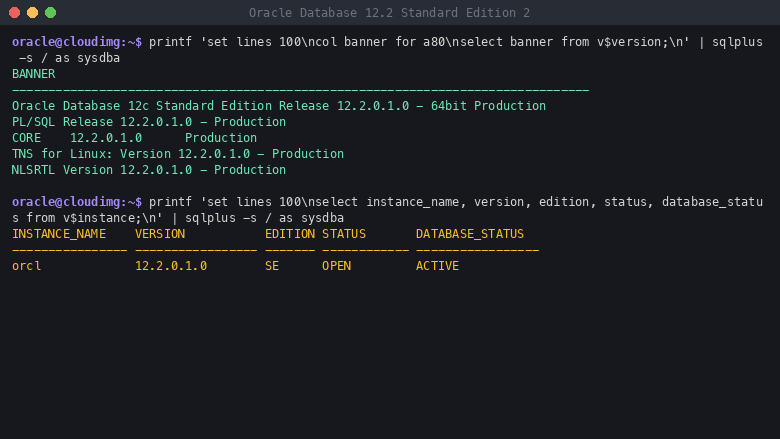
Oracle Database 12.2 Standard Edition 2
Image
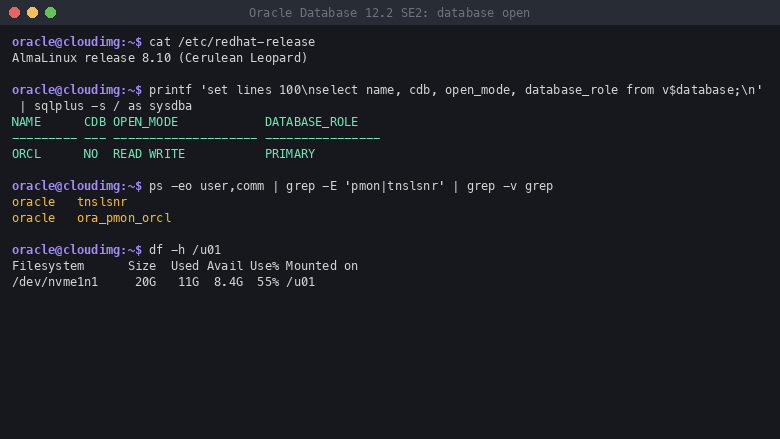
Database ORCL open read write on AlmaLinux 8
Image
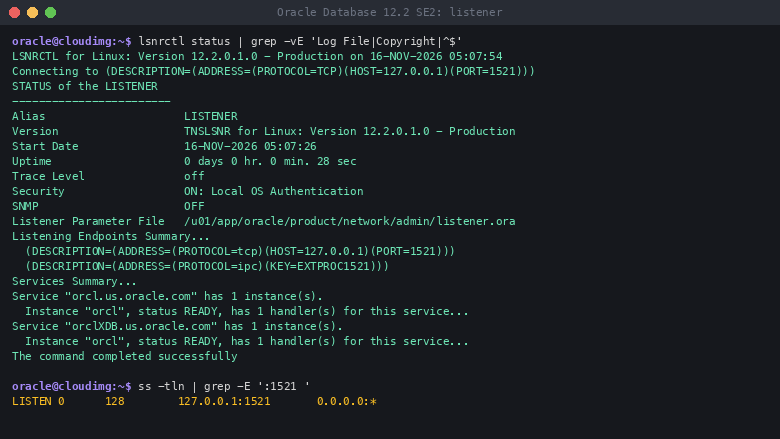
Oracle 12.2 listener on 127.0.0.1 port 1521
This is a repackaged software product wherein additional charges apply for the installation, configuration and packaging of the software in this image by cloudimg.
Oracle Database 12c Release 2 (12.2.0.1) is end of life: Oracle stopped issuing patches for it in 2022, so it gets no new fixes, security fixes included; use this image for legacy applications, testing and migration. This image ships the 12.2.0.1 base release with no Oracle Release Update.
What cloudimg adds to Oracle Database 12c Release 2
This image installs Oracle Database 12c Release 2 (12.2.0.1, 64 bit) Standard Edition 2 on Amazon EC2, on a fully updated AlmaLinux 8, and creates a working database, so you start with a 12.2 server instead of an installer. You get:
- Passwords set on your own instance: on first boot the instance sets new random SYS and SYSTEM passwords that no other instance has, checks each one logs in, and writes them to /root/oracle-db-credentials.txt, readable by root only
- A loopback-only listener: the Oracle listener and every Oracle network endpoint answer on 127.0.0.1 only, so you connect on the instance or through an SSH tunnel; nothing Oracle listens on the instance's network addresses
- Oracle software on its own EBS volume: installed under /u01/app/oracle on a dedicated 20 GB /u01 volume
- A database created for you: a single-instance ORCL database (non-CDB), service orcl.us.oracle.com, with a tnsnames.ora entry
- A dedicated oracle OS user with setEnv.sh, start_all.sh and stop_all.sh in its home directory
- AWS tools: AWS CLI v2 and the SSM Agent; the CloudWatch Agent is installed but not configured
- A step-by-step user guide covering launch, the first-boot passwords, start-up, SQL*Plus and SQL Developer through an SSH tunnel
Earlier subscribers: versions dated 13-11-2026 and earlier shipped one build-time SYS and SYSTEM password; the user guide says how to change it.
The edition: Standard Edition 2
SE2 may be licensed only on servers with up to two sockets, and an SE2 database uses at most 16 CPU threads; check Oracle's cloud licensing policy for how vCPUs are counted. Grid Infrastructure (ASM) is not installed on this image, and Enterprise Edition options are not part of SE2. AlmaLinux is not on Oracle's certified platform list.
Licence
This listing does not include an Oracle Database licence. You must hold a valid Oracle Database Standard Edition 2 licence for the instance and use it under your agreement with Oracle.
Who it is for
- Teams that must keep an Oracle 12.2 application running while they plan an upgrade
- DBAs rehearsing a 12.2 to 19c migration with Data Pump
- Software vendors testing support for customers still on Oracle 12.2
- Development, QA and training environments that must match an existing 12.2 estate
Getting started
- Subscribe, choose the AlmaLinux 8 version and launch the instance (m5.large or larger is recommended). Change the suggested security group's SSH source to your own IP.
- SSH in as ec2-user and read this instance's passwords with sudo cat /root/oracle-db-credentials.txt.
- Run sudo su - oracle, then . ./start_all.sh to start the listener and the database (the database does not start at boot).
- Connect with sqlplus / as sysdba after . ./setEnv.sh, or from SQL Developer through ssh -L 1521:127.0.0.1:1521.
Full steps, paths and troubleshooting are in the user guide linked on this page.
Oracle and Java are registered trademarks of Oracle and/or its affiliates. Other names may be trademarks of their respective owners. cloudimg is not affiliated with or endorsed by Oracle.
Highlights
- Oracle Database 12c Release 2 (12.2.0.1) Standard Edition 2 on AlmaLinux 8 with an ORCL database; SYS and SYSTEM passwords set on each instance's first boot, root-only file.
- The listener answers on 127.0.0.1:1521 only: connect through an SSH tunnel. Oracle on a dedicated 20 GB /u01 EBS volume; oracle user with start and stop scripts; step-by-step guide.
- Oracle 12.2 is past the end of Oracle's support and gets no new patches: use it for legacy applications, testing and migration. Needs your own Oracle SE2 licence.
Features and programs
Financing for AWS Marketplace purchases
AWS Marketplace now accepts line of credit payments through the PNC Vendor Finance program. This program is available to select AWS customers in the US, excluding NV, NC, ND, TN, & VT.

Pricing
Free trial
Try this product free for 7 days according to the free trial terms set by the vendor. Usage-based pricing is in effect for usage beyond the free trial terms. Your free trial gets automatically converted to a paid subscription when the trial ends, but may be canceled any time before that.
Pricing is based on actual usage, with charges varying according to how much you consume. Subscriptions have no end date and may be canceled any time. Alternatively, you can pay upfront for a contract, which typically covers your anticipated usage for the contract duration. Any usage beyond contract will incur additional usage-based costs.
Additional AWS infrastructure costs may apply. Use the AWS Pricing Calculator to estimate your infrastructure costs.
If you are an AWS Free Tier customer with a free plan, you are eligible to subscribe to this offer. You can use free credits to cover the cost of eligible AWS infrastructure. See AWS Free Tier for more details. If you created an AWS account before July 15th, 2025, and qualify for the Legacy AWS Free Tier, Amazon EC2 charges for Micro instances are free for up to 750 hours per month. See Legacy AWS Free Tier for more details.
- ...
Dimension | Description | Cost/hour |
|---|---|---|
m5.large Recommended | m5.large | $0.10 |
t2.micro | t2.micro instance type | $0.06 |
t3.micro | t3.micro instance type | $0.06 |
m7a.large | m7a.large instance type | $0.10 |
m7i-flex.xlarge | m7i-flex.xlarge instance type | $0.15 |
m7i.large | m7i.large instance type | $0.10 |
t3.small | t3.small instance type | $0.06 |
x1e.32xlarge | x1e.32xlarge instance type | $0.28 |
r5b.24xlarge | r5b.24xlarge instance type | $0.28 |
p3.2xlarge | p3.2xlarge instance type | $0.28 |
Dimensions summary
You pay by the hour for the EC2 instance type you run this Oracle Database 12.2 Standard Edition 2 AMI on. Each dimension maps to one instance type, so the only choice that changes your rate is the hardware size you select. Pricing scales with instance size and family. Smaller shared types like t3.small cost less per hour, while large memory, compute, storage, and accelerated families cost more. You run the image on your chosen instance and stop billing when you stop the instance. The vendor recommends m5.large or larger for the database.
Top-of-mind questions for buyers
You pay the hourly software rate for running the AMI on that one EC2 instance type. The rate reflects the hardware size and family you pick. This covers the preinstalled Oracle Database 12c Standard Edition 2 software, helper scripts, and vendor email support, separate from the underlying AWS compute charge.
The hourly software charge meters running time only. When you stop the instance, the hourly rate stops accruing. Stopped instances may still incur AWS storage fees for the root volume and the dedicated Oracle /u01 volume, but those are separate AWS charges, not the software rate.
The vendor recommends m5.large, which has 2 vCPU and 8 GB RAM, or larger. The stated minimum is 1 vCPU, 1 GB RAM, and 20 GB disk space. Oracle Database benefits from more memory for production workloads, so a larger instance may change your hourly rate.
www.cloudimg.co.uk
Helpful?
Vendor refund policy
Refunds available on request.

Legal
Vendor terms and conditions
Upon subscribing to this product, you must acknowledge and agree to the terms and conditions outlined in the vendor's End User License Agreement (EULA) .
Content disclaimer
Vendors are responsible for their product descriptions and other product content. AWS does not warrant that vendors' product descriptions or other product content are accurate, complete, reliable, current, or error-free.
Delivery details
64-bit (x86) Amazon Machine Image (AMI)
Amazon Machine Image (AMI)
An AMI is a virtual image that provides the information required to launch an instance. Amazon EC2 (Elastic Compute Cloud) instances are virtual servers on which you can run your applications and workloads, offering varying combinations of CPU, memory, storage, and networking resources. You can launch as many instances from as many different AMIs as you need.
Version release notes
Security rebuild. Oracle Database 12c Release 2 (12.2.0.1) Standard Edition 2 from Oracle's base release media, no Release Update (12.2 is end of life: Oracle issues no more patches for it), on a fully updated AlmaLinux 8.10 (kernel 4.18.0-553.186.1.el8_10). Each instance now sets its own SYS and SYSTEM passwords on first boot and writes them to /root/oracle-db-credentials.txt, readable by root only; earlier versions shipped one build-time password in a file any user could read, which this image no longer contains or accepts. The listener, LOCAL_LISTENER and the XDB dispatcher answer on 127.0.0.1 only: connect on the instance or through an SSH tunnel. The database still starts with start_all.sh as the oracle user. Bring your own Oracle Database Standard Edition 2 licence. Recommended: m5.large.
Additional details
Usage instructions
Connect with SSH on port 22 as ec2-user with your key pair: ssh -i key.pem ec2-user@<public-ip> The SYS and SYSTEM passwords are generated on this instance's first boot, unique to it, about 2 to 3 minutes after launch. Read them with: sudo cat /root/oracle-db-credentials.txt (readable by root only). The database does not start at boot. Start the listener and the database with: sudo su - oracle, then . ./start_all.sh The listener answers on 127.0.0.1:1521 only. Connect on the instance (. ./setEnv.sh, then sqlplus / as sysdba) or through an SSH tunnel: ssh -i key.pem -N -L 1521:127.0.0.1:1521 ec2-user@<public-ip>, then localhost:1521, service orcl.us.oracle.com. Never open TCP 1521 in the security group. The suggested security group allows SSH (22) from anywhere: change the source to your own IP. Oracle Database 12.2 is end of life: Oracle issues no more patches for it. Bring your own Oracle Database Standard Edition 2 licence. Guide: https://www.cloudimg.co.uk/guides/oracle-database-12-2-standard/
Resources
Vendor resources
Support
Vendor support
cloudimg's support team is on hand 24 hours a day by email for this image, with a guaranteed response within 24 hours: launch and first login, the Oracle listener, SID and tablespace set-up, backup and recovery planning, instance sizing, CloudWatch, SSM Agent and ENA configuration, bring-your-own-licence questions, updates and troubleshooting. Contact: support@cloudimg.co.uk or https://www.cloudimg.co.uk/support Oracle software support, patches and licences come from Oracle under your own agreement.
AWS infrastructure support
AWS Support is a one-on-one, fast-response support channel that is staffed 24x7x365 with experienced and technical support engineers. The service helps customers of all sizes and technical abilities to successfully utilize the products and features provided by Amazon Web Services.
Similar products
This product has charges associated with it for the installation, configuration and packaging of Oracle Database 11g. Oracle Database 11g Standard Edition 11.2.0.4 on AlmaLinux 8.10: a non-CDB ORCL database, per-instance SYS/SYSTEM passwords and a loopback listener. For legacy and migration use. Bring your own Oracle licence.
This product has charges associated with it for installing and configuring Oracle Database 12c Release 2 Enterprise Edition (12.2.0.1) on AlmaLinux 8, with an ORCL sample database and start scripts. End of life, no more Oracle patches: for legacy, test and migration use. Bring your own Oracle licence.
This product has charges associated with it for the installation, configuration and packaging of Oracle Database 19c in these images. Standard Edition 2 (19.3) on Oracle Linux 9 or AlmaLinux 8: first boot creates the ORCL database with unique SYS and SYSTEM passwords per instance; listener on 127.0.0.1 only. Bring your own Oracle licence.
This product has charges associated with it for building Oracle Database 21c Standard Edition 2 (21.3 base release) on Oracle Linux 8 (updated at build), with the database and its SYS, SYSTEM and PDBADMIN passwords created per instance at first boot and a listener on 127.0.0.1 only. Bring your own Oracle licence.
Customer reviews
No customer reviews yet
Be the first to review this product . We've partnered with PeerSpot to gather customer feedback. You can share your experience by writing or recording a review, or scheduling a call with a PeerSpot analyst.