Sold by: ProvenCloud
Deployed on AWS
Free Trial
This is a repackaged open source software product wherein additional charges apply for a secure, ready-to-use Qdrant 1.20 vector database stack with JupyterLab and MinIO storage. Build semantic search and RAG apps on your own server, with a vector database, object storage and notebooks linked from one start page.
Overview
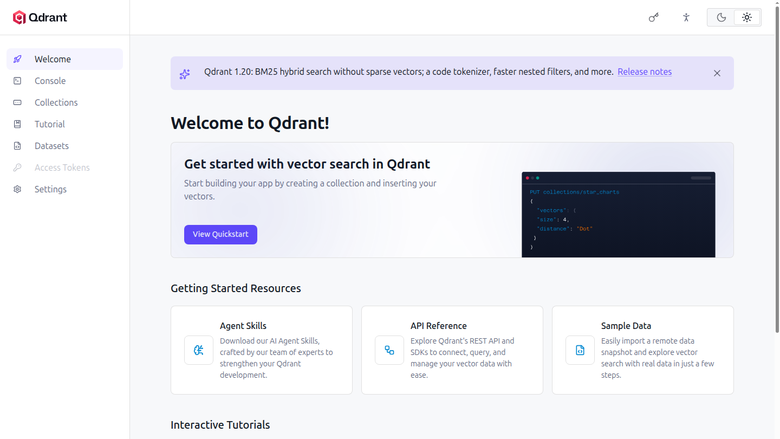
Fast vector search for AI apps
Qdrant is an open source vector database for storing embeddings and finding similar items fast. It powers semantic search, recommendations and retrieval-augmented generation (RAG) for AI assistants. This image gives AI developers and data teams a complete starter stack in minutes: the vector database, object storage for documents, and a notebook environment to build in.
Who it is for
- AI developers building RAG and semantic search
- Data teams storing and searching embeddings
- Startups prototyping recommendation features
What is included
- Qdrant 1.20.0 with its web dashboard on Ubuntu 24.04 LTS
- MinIO S3-compatible object storage with its console
- JupyterLab with the Python client libraries and a starter notebook
- An Nginx landing page on port 80 that links everything together
- Helper scripts pass_jupyter.sh, pass_minio.sh and qdrant_status.sh
Secure by default
- Every instance sets its own JupyterLab password on first boot
- Qdrant's API stays on the server itself
- Change the MinIO console password with pass_minio.sh before you store real data, and limit every port to your own IP; SSH accepts key-based login only
Get started in 4 steps
- Launch the instance (t3a.large recommended) and allow ports 22, 80, 8888, 9000 and 9001 from your own IP only
- Wait about 3 minutes, then open http:// to see the start page
- Run pass_minio.sh over SSH to set your own MinIO password
- Open JupyterLab, run the starter notebook and create your first collection
Example use case
A legal-tech startup builds search over 50,000 contracts. In JupyterLab it splits each contract into passages, creates embeddings with a sentence-transformers model, stores them in a Qdrant collection, keeps the original PDFs in MinIO, and answers questions such as 'contracts with a 90-day termination clause'.
About ProvenCloud
ProvenCloud builds and maintains 50 ready-to-use server images on AWS Marketplace. Every image is built from official sources, scanned by AWS Marketplace before each release, and rebuilt when an important security fix ships: in November 2026 we rebuilt and re-released 29 products for CVE-2026-111497. Our Zabbix solution has passed the AWS Foundational Technical Review.
What you get from ProvenCloud on top of the free software
A pre-built and tested image that is ready in minutes, a unique security setup for every server, simple scripts for changing passwords, regular image updates, and help by email whenever you need it. Qdrant is open source software licensed under Apache-2.0, MinIO under AGPL-3.0, and JupyterLab under BSD-3-Clause. Qdrant is a trademark of Qdrant Solutions GmbH, and MinIO is a trademark of MinIO, Inc. This image is an independent build by ProvenCloud.
Highlights
- Ready in minutes: launch the instance and open the landing page for links to the Qdrant dashboard, JupyterLab and the MinIO console. A starter notebook shows the whole stack working.
- Simple to secure: JupyterLab gets its own password on first boot, Qdrant API stays on the server, SSH is key-only, and one script (pass_minio.sh) sets your own MinIO password before you store real data.
- Everything for AI search: store embeddings in Qdrant, keep documents in S3-compatible MinIO, and write your RAG or semantic search code in JupyterLab.
Details
Sold by
Categories
Delivery method
Delivery option
64-bit (x86) Amazon Machine Image (AMI)
Latest version
Operating system
Ubuntu 24.04
Deployed on AWS
Features and programs
Financing for AWS Marketplace purchases
AWS Marketplace now accepts line of credit payments through the PNC Vendor Finance program. This program is available to select AWS customers in the US, excluding NV, NC, ND, TN, & VT.

Pricing
Free trial
Try this product free for 5 days according to the free trial terms set by the vendor. Usage-based pricing is in effect for usage beyond the free trial terms. Your free trial gets automatically converted to a paid subscription when the trial ends, but may be canceled any time before that.
Pricing is based on actual usage, with charges varying according to how much you consume. Subscriptions have no end date and may be canceled any time. Alternatively, you can pay upfront for a contract, which typically covers your anticipated usage for the contract duration. Any usage beyond contract will incur additional usage-based costs.
Additional AWS infrastructure costs may apply. Use the AWS Pricing Calculator to estimate your infrastructure costs.
- ...
Dimension | Cost/hour |
|---|---|
t3a.large Recommended | $0.04 |
c3.2xlarge | $0.10 |
c3.4xlarge | $0.10 |
c3.8xlarge | $0.10 |
c4.2xlarge | $0.10 |
c4.4xlarge | $0.10 |
c4.8xlarge | $0.10 |
c5.12xlarge | $0.10 |
c5.2xlarge | $0.10 |
c5.4xlarge | $0.10 |
Dimensions summary
You pay by the hour for the EC2 instance type you run this image on. The software itself carries no license fee, since it bundles open-source components. Pricing scales with the instance you choose, not with users or data volume. The many dimensions all represent EC2 instance types across families such as compute-optimized (c), general-purpose (m), memory-optimized (r), storage (d, i), and GPU/accelerated (g, p, inf, trn) options. Each family offers sizes from large through metal, so hourly cost rises as you pick instances with more vCPUs, memory, or accelerators. You also pay AWS for compute and storage.
Top-of-mind questions for buyers
Each dimension maps to one EC2 instance type, defining vCPUs, memory, and any attached accelerators. For example, compute-optimized (c) families favor processing power, memory-optimized (r) families favor RAM, and GPU families (g, p) add accelerators. You pick the size that matches your vector search and indexing workload.
Hourly software charges apply only while the instance runs. A stopped instance accrues no hourly software fee. You may still pay AWS for the attached storage volume, since the 30 GiB gp3 root volume persists while stopped. Charges resume when you restart the instance.
No. The image bundles open-source software that needs no license key, so you pay no separate license fee. Your hourly charge covers the running EC2 instance type you select. You also pay AWS directly for compute time and storage the instance uses.
www.provencloud.io+1
Helpful?
Vendor refund policy
Software charges are billed hourly, only while your instance runs. You can stop charges at any time by terminating the instance or cancelling your subscription. Charges already incurred are not refundable.

Legal
Vendor terms and conditions
Upon subscribing to this product, you must acknowledge and agree to the terms and conditions outlined in the vendor's End User License Agreement (EULA) .
Content disclaimer
Vendors are responsible for their product descriptions and other product content. AWS does not warrant that vendors' product descriptions or other product content are accurate, complete, reliable, current, or error-free.
Delivery details
64-bit (x86) Amazon Machine Image (AMI)
Amazon Machine Image (AMI)
An AMI is a virtual image that provides the information required to launch an instance. Amazon EC2 (Elastic Compute Cloud) instances are virtual servers on which you can run your applications and workloads, offering varying combinations of CPU, memory, storage, and networking resources. You can launch as many instances from as many different AMIs as you need.
Version release notes
Existing servers keep running as they are and need no action. New launches get this version. To apply the same Ubuntu security fixes to a server you already run, connect over SSH and run sudo apt update && sudo apt full-upgrade.
Qdrant 1.20.0 (was 1.19.1) on Ubuntu 24.04 LTS with MinIO, JupyterLab and an Nginx landing page, with all current Ubuntu security updates, including the Brotli library fix for CVE-2026-111497.
Unique JupyterLab and MinIO passwords are set for every instance on first boot.
Includes helper scripts in /home/ubuntu/iscripts for changing passwords.
Additional details
Usage instructions
Once the instance is running, enter http://<instance-public-ip> into your browser to see the landing page. The Qdrant dashboard is at http://<instance-public-ip>/dashboard/. JupyterLab is at http://<instance-public-ip>:8888; sign in with your instance ID as the password. The MinIO console is at http://<instance-public-ip>:9001; sign in with admin as the username and your instance ID as the password, and the MinIO S3 API is on port 9000. You can also connect over SSH with the username ubuntu and your Amazon key pair.
Required inbound ports: 22 (SSH), 80 (landing page and Qdrant dashboard), 8888 (JupyterLab), 9001 (MinIO console) and 9000 (MinIO S3 API). For security, allow all of these only from your own IP address.
Your instance ID is shown in the EC2 console, for example i-0123456789abcdef0. Every instance sets its own passwords on first boot, so no two instances share a password. Allow two to three minutes after launch for the first-boot setup to finish before you sign in.
Open notebooks/01-quickstart.ipynb in JupyterLab to try the stack. Change your passwords with sudo bash /home/ubuntu/iscripts/pass_jupyter.sh for JupyterLab or pass_minio.sh for MinIO, and run qdrant_status.sh to see versions and health.
The image serves plain HTTP so it works on a bare IP address. Before using it in production, add your own domain and an SSL certificate, or place it behind a load balancer with HTTPS.
Resources
Vendor resources
Support
Vendor support
Email: support@provencloud.io
Support page: https://www.provencloud.io/support
Response time: we reply to every support email within 1 business day.
Hours: Monday to Friday, 10:00 to 19:00 IST (UTC+05:30)
Help with: first sign-in, passwords, domains and HTTPS, configuration questions, and upgrading to new versions.
Billing and refunds for this subscription are handled by AWS Marketplace.
AWS infrastructure support
AWS Support is a one-on-one, fast-response support channel that is staffed 24x7x365 with experienced and technical support engineers. The service helps customers of all sizes and technical abilities to successfully utilize the products and features provided by Amazon Web Services.
Similar products

This is a repackaged open source software product wherein additional charges apply for hardening, security configuration, and setup support.
Qdrant is an open-source, high-performance vector database for AI and semantic search - used in RAG pipelines, recommendation systems, LangChain, LlamaIndex, and any workload requiring similarity search over embeddings. This Lynxroute build is security baked in: unique API key at first boot, UFW firewall pre-configured, and CIS Level 1 hardened Ubuntu 24.04 LTS base.
Web UI included. fastembed pre-installed for local embedding without external API calls.
Apache-2.0 license - fully auditable, no vendor lock-in.

Qdrant is an open-source and fully managed high-performance Vector Database. The vector search engine provides a production-ready service with a convenient API to store, search, and manage vector embeddings.
This is a repackaged open source software product wherein additional charges apply for a secure, ready-to-use Langflow 1.13.0 visual AI workflow builder. Build and test AI agents, chatbots and RAG pipelines on a visual canvas, then call each one as an API, on your own server with your own model keys. Every instance gets its own passwords.
This is a repackaged open source software product wherein additional charges apply for a secure, ready-to-use Ollama 0.40.13 AI server with Open WebUI v0.12.5. Chat with open AI models privately in your browser about 4 minutes after launch, with a model already downloaded and your chats and documents kept on your own server.
Customer reviews
No customer reviews yet
Be the first to review this product . We've partnered with PeerSpot to gather customer feedback. You can share your experience by writing or recording a review, or scheduling a call with a PeerSpot analyst.