AWS Cloud Operations Blog
Category: Amazon CloudWatch
An AI Observability Framework for Your Agentic Applications
Best practices for every layer, from the first prototype to production Agents have moved beyond proof of concept. IDC’s July 2026 survey found that 95% of enterprises now run at least one agent-enabled workflow in production, and 67% exceeded their agent budgets by more than 10% in the past year. Gartner predicts that more than […]
Three questions to ask about AI inference in Amazon EKS, and how Amazon CloudWatch answers them
GPUs are expensive and scarce. On a cluster shared by several AI teams, an idle GPU costs you twice: once on the bill, and again as capacity a team is waiting for. Three questions follow: which workload holds each GPU, how well it uses it, and which workloads are affected when one GPU goes bad. […]
Investigate security data in place with Amazon CloudWatch and 7AI
Security teams don’t struggle to get alerts. They struggle to get the context needed to act on them. Consider a common scenario: an AWS Security Hub finding reports a critical vulnerability in a container image in Amazon Elastic Container Registry. The finding says that a package is vulnerable, but not whether the image is running, […]
Best practices for deploying Amazon CloudWatch Omni at enterprise scale
At enterprise scale, organizations run applications and AI agents side by side across hundreds of AWS accounts, several Regions, and often other clouds and on-premises data centers. Site reliability engineering (SRE) teams watch service latency, agent developers observe agent traces and evaluation scores, operation teams monitor alerts, and security reviews AWS API activity. When a […]
Bring AWS Security Hub CSPM findings into your Amazon CloudWatch on-call workflow
At 2:47 AM, an on-call engineer gets paged: CPU on a production Amazon EC2 instance has been above 95% for five minutes. They open Amazon CloudWatch and run the usual triage, checking recent deployments, traffic spikes, memory, and disk I/O. Nothing lines up. They scale the instance; utilization climbs back within minutes. Thirty-two minutes later, […]
Profile your Amazon CloudWatch Logs estate with an AWS DevOps Agent skill in sandbox, no infrastructure to deploy.
A zero-infrastructure AWS DevOps Agent skill profiles your Amazon CloudWatch Logs estate and gives you one view of it. CloudWatch Logs already captures the signals you need to operate it well, including how each log group is classed, how long it is kept, who reads it, where its data flows, and how fast it grows. […]
This Month in AWS Observability: August – September 2026
Introduction August and September brought the general availability of Amazon CloudWatch Omni, an AI-first, app-centric observability experience that brings together telemetry across AWS accounts, Regions, and Azure workloads in a single space. Alarms gained warm-up periods and wall clock evaluation windows, cutting the noise that comes from startup gaps and rolling-window edge cases. Database observability […]
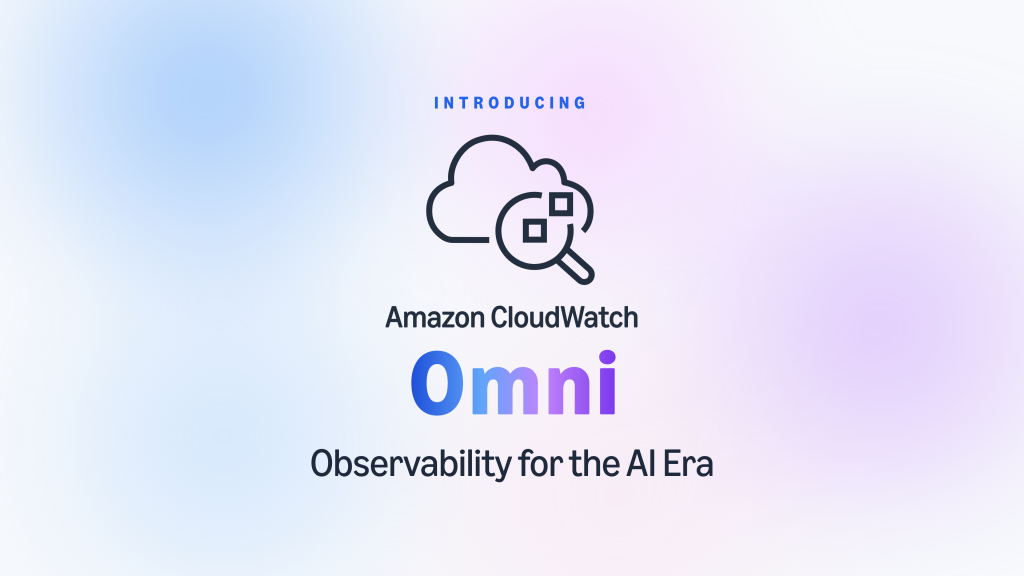
Introducing Amazon CloudWatch Omni: Observability for the AI Era
An AI-powered observability experience for AI agents and applications, built on open standards and delivered outside of the AWS Console. Organizations are handing agents the keys to their day-to-day operations, from resolving support tickets and managing infrastructure to approving expenses, shipping production code, and increasingly the long tail of workflows that keep the business running. […]
This Month in AWS Observability: July 2026
Introduction July was a busy month for AWS Observability. We launched features to make the telemetry you already collect more actionable, and take the operational work of collecting it off your hands. Log analytics moved closer to action with alarms that run straight from a log query and enrichment that happens at ingestion. Application-level observability […]
Multi-Cloud Observability with Amazon CloudWatch Using Bearer Token Auth and OpenTelemetry
Organizations running serverless workloads across multiple cloud providers face a specific observability challenge. There is no persistent compute to host a telemetry collector, no sidecar to attach, and no daemon running between invocations. The standard OpenTelemetry deployment model (application to local collector to a telemetry backend) does not apply in this environment. Authentication presents an […]