Artificial Intelligence
How Deepgram optimized voice AI at scale with AWS Trainium
November 2026: This post was reviewed and updated for accuracy.
As voice becomes a first-class modality for AI, Deepgram’s models span speech-to-text, text-to-speech, and voice agents. Customers use them through the Deepgram API or run them in their own environments, including on Amazon SageMaker AI.
For Deepgram, serving efficiency determines how much audio the system can process for a given infrastructure budget. High-volume batch workloads put heavy pressure on that budget, so the more efficiently each accelerator hour is used, the more audio Deepgram can serve on the same fleet. That made inference efficiency a natural target and Deepgram turned to AWS AI chips to improve it. They worked with AWS to bring its Nova-3 speech-to-text model to AWS Trainium2 for offline batch workloads such as contact-center analytics and medical transcription.
The engagement began with Deepgram delivering Nova-3 as standard PyTorch code. Over several months, Deepgram and the AWS Forward Deployed Engineering (FDE) team ported Nova-3 to AWS Trainium2 in PyTorch reconstruction and tuned it for the new hardware. The final configuration runs multiple model replicas on a single Amazon Elastic Compute Cloud (Amazon EC2) trn2.3xlarge instance. On Deepgram’s offline, throughput-oriented batch workloads, that setup delivered meaningful price-performance gains over the other compute options in our evaluation. We measured this using instance pricing at the time of the evaluation. These gains help Deepgram scale efficiently, keep shipping better models, and bring them to customers at lower prices. These benefits can extend to customers who self-host Deepgram models in their own virtual private cloud (VPC) on Amazon SageMaker AI. There, Deepgram and AWS continue to improve ease of setup, reliability, and observability.
In this post, we walk through the full inference optimization effort on Trainium: porting Nova-3 to the AWS Neuron software stack, the kernel-level tuning that followed, and how Deepgram integrated the compiled model into its serving stack.
Optimizing Nova-3 to Trainium2 with native PyTorch
Starting with standard PyTorch code, we used TorchNeuron, the native PyTorch integration of the Neuron Compiler, which supports both eager execution and torch.compile. We ran Nova-3 in eager mode on Trainium2 first and checked which operations fell back to the CPU, then compiled with torch.compile. The compiled path ran every model operation on Trainium2 with no CPU fallbacks detected.
Throughout, we checked numerical accuracy at two levels: layer-level output consistency against CPU, and the end-to-end Word Error Rate (WER), which had to stay in line with Deepgram’s reference values and target.
From that working baseline, we kicked off the optimization work by replacing several layers with fused kernels from the public NKI Library (NKILib), a collection of pre-built reference kernels written with the Neuron Kernel Interface (NKI).
We optimized for throughput and, by extension, cost efficiency, targeting Deepgram’s offline inference workloads.
Kernel-level tuning with Neuron Explorer and NAD
Enabling kernels is only the first step of an optimization cycle: enable an NKI kernel (custom or from NKILib), profile the workload, then either tune the existing kernel or replace it with a new one based on the profiling insights. This cycle repeats until the performance target is met. At each step, a different part of the Neuron stack accelerates the work: NKILib provides drop-in replacement kernels, Neuron Explorer is the go-to tool for profiling Neuron workloads, and the Neuron Agentic Development (NAD) toolkit speeds up profiling analysis and kernel tuning through its profiling and kernel-writing skills.
In our case, the NKILib kernels got us most of the way, and profiling showed where a hand-written kernel would do better. Each time, the NAD profiling skills took us from a Neuron Explorer profile to a root cause, and the NAD kernel-writing skills helped produce the replacement kernels.
Profiling identified several layers where hand-tuned kernels outperformed the reference kernels or the default compiled implementation, with gains of 1.5x to 50x at the module level.
Serving integration
We ran multiple model replicas per device so that inputs are processed concurrently while maximizing per-device throughput.
Deepgram integrated the compiled model into its existing serving stack through the Neuron Runtime API.
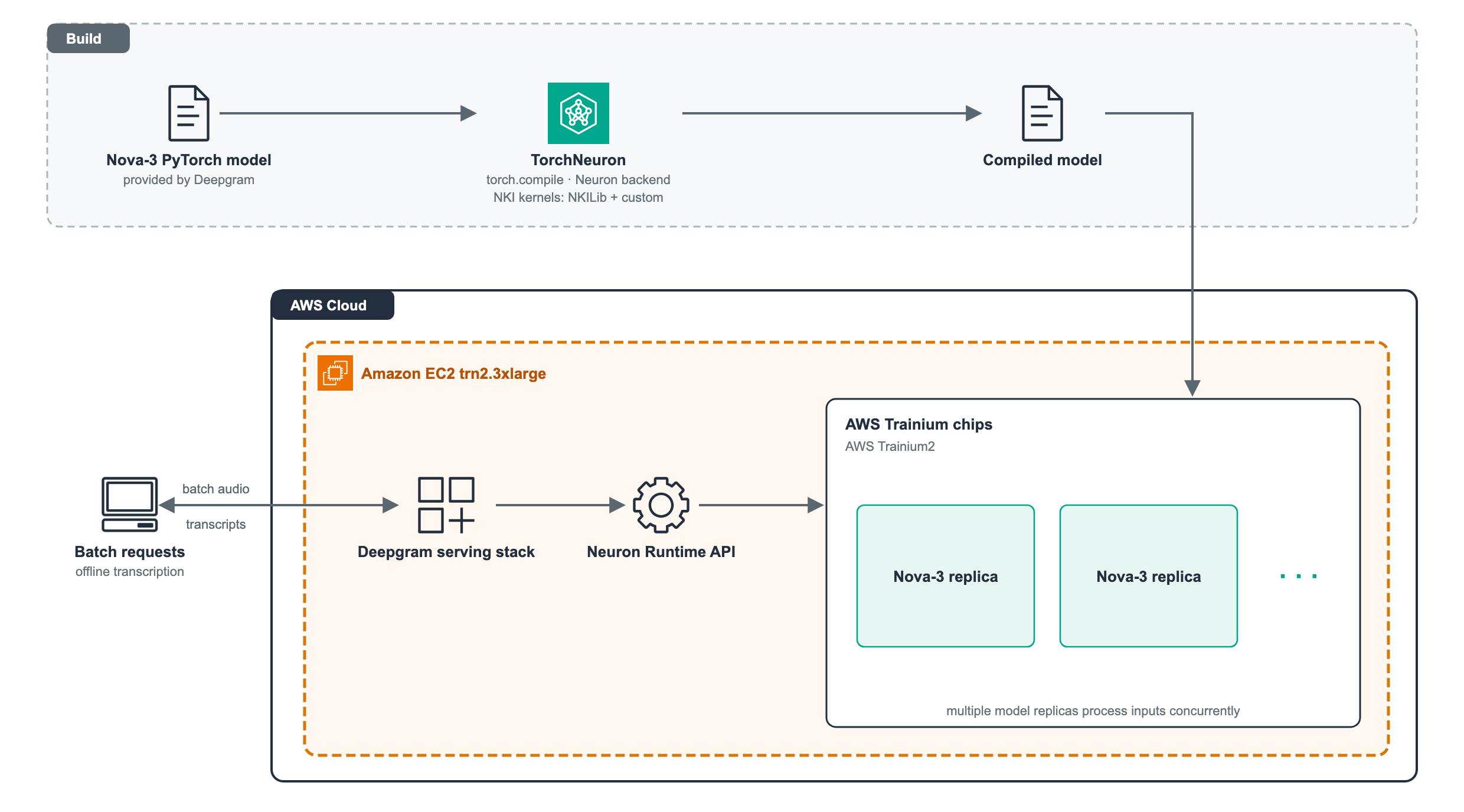
Figure 1: Deepgram Nova-3 on AWS Trainium2, compiled with TorchNeuron and served with multiple model replicas
Cost saving impact
We measured price-performance as audio processed per dollar. On Deepgram’s offline, throughput-oriented batch workloads, the single-device Trainium2 setup (trn2.3xlarge) delivered meaningful price-performance gains over the other compute options in our evaluation.
Conclusion
In this post, we demonstrated how Deepgram and the AWS FDE ported the Nova-3 speech-to-text PyTorch model to Trainium hardware using TorchNeuron, which provides native PyTorch framework integration for AWS Trainium. We improved performance by replacing layers directly with pre-built kernels from NKILib. We then assessed performance using Neuron Explorer and used the Neuron Agentic Development (NAD) profiling skills to query profiling data and accelerate performance troubleshooting. Building on these insights, we adapted kernel source code using the NAD kernel-writing skills. Finally, Deepgram integrated the compiled model into its existing serving stack through the Neuron Runtime API. Our setup demonstrated cost savings in offline, throughput-oriented scenarios, validating AWS Trainium as a viable and efficient option for Deepgram’s offline batch workloads.
To try this approach on your own models, start with the AWS Neuron documentation, which covers the compiler, the runtime, and the supported frameworks. The Neuron Kernel Interface (NKI) guide explains how to write the kernels described in this post, and the NKI samples repository holds the reference kernels we started from. The Neuron developer tools documentation covers the profiling and agentic tooling we used here, including Neuron Explorer and Neuron Agentic Development. For instance sizes and pricing, see Amazon EC2 Trn2 Instances. For help scoping a similar port, contact the AWS Forward Deployed Engineering.