AWS Storage Blog
Category: Analytics
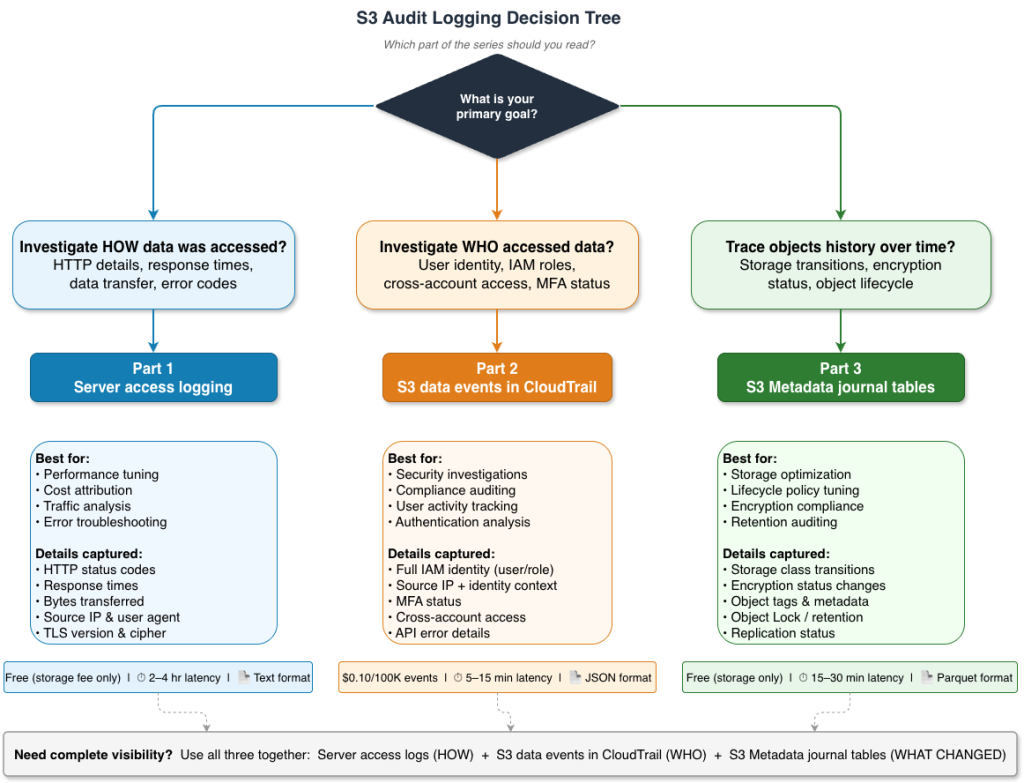
Amazon S3 audit logging, Part 1: Analyzing server access logs with Amazon Athena for performance insights
Organizations storing sensitive data must maintain complete visibility into how it’s accessed, by whom, and what changes occur over time. Regulatory frameworks demand detailed audit trails, security teams need rapid answers during investigations, and finance teams require granular cost attribution. Yet as data grows from terabytes to petabytes, the scale that makes centralized storage attractive […]

Data discovery: How to find out what’s on your Amazon FSx for NetApp ONTAP volumes
Enterprise storage administrators manage hundreds of terabytes, and sometimes petabytes, of file data spanning business units, applications, and users. As that storage grows, so does the challenge of understanding what is actually stored in it. Administrators are asked to make capacity decisions, identify archive candidates, track storage costs, and support compliance reviews — but with […]

Enabling natural language access to structured data using Amazon S3 Tables and Amazon Bedrock Knowledge Bases
Organizations generate massive volumes of structured data from customer transactions, operational metrics, product catalogs, and compliance records. This data contains insights that can help businesses make better and timely decisions. Financial advisors need to review client transaction histories, retail analysts track inventory trends, and healthcare administrators monitor patient outcomes. Yet accessing these insights creates a […]

Accelerate Apache Hadoop and Apache Iceberg on Amazon S3 with the Analytics Accelerator Library
Organizations processing large-scale data for analytics, machine learning (ML), and business intelligence face a persistent challenge: how to access and read massive datasets quickly and cost-effectively. As data volumes grow exponentially, the performance of data access patterns becomes more critical. Inefficient read operations can lead to longer processing times, higher compute costs, and delayed insights, […]

Building automated AWS Regional availability checks with Amazon S3
Every day, organizations expand into new markets, migrate critical workloads across geographies, and build systems that need to operate reliably in multiple locations. At the root of these efforts is a simple question: “What can I deploy, and where?” The answer shapes important architecture decisions, from which AWS Regions to expand into, to how you […]

Applying Amazon S3 Object Lock at scale for petabytes of existing data
Organizations with petabytes of data in the cloud need a way to apply immutable storage protections to data that’s already been stored—whether for regulatory compliance or cyber resilience. Although you can enable write-once-read-many (WORM) controls for newly created storage, applying these protections to existing enterprise data at scale requires a systematic approach. Regulated industries have […]
Real-time fleet tracking using AWS IoT Core, Amazon S3 Tables, and Amazon Quick Sight
The fast pace of the logistics industry necessitates real-time vehicle fleet tracking for maintaining a competitive edge and meeting customer expectations. Traditional methods often provide delayed or incomplete information, leading to inefficiencies and missed opportunities. The demand for accurate, up-to-the-minute data on vehicle locations, driver behavior, and route performance has never been higher. Companies need […]
Building an open warehouse architecture: Supabase’s integration with Amazon S3 Tables
As applications scale, developers face a persistent challenge: analytical queries that slow down transactional databases, force them to copy data across multiple proprietary tools, and create disconnected data silos. For the 5 million developers building on Supabase, an open source Postgres development platform, this tension between operational and analytical workloads has become increasingly critical. The […]
Build intelligent ETL pipelines using AWS Model Context Protocol and Amazon Q
Data scientists and engineers spend hours writing complex data pipelines to extract, transform, and load (ETL) data from various sources into their data lakes for data integration and creating unified data models to build business insights. The process involves understanding the source and target systems, discovering schemas, mapping source and target, writing and testing ETL […]

Optimizing recommendations and analytics using Amazon DynamoDB and Amazon S3
Today, consumers navigate thousands of products on e-commerce sites, hundreds of shows on streaming platforms, and countless options in digital marketplaces. This choice overload creates decision fatigue, yet consumers continue to demand more variety and make more purchases online. As a result, personalization has become essential—consumers reward brands that deliver relevant, tailored online experiences. However, […]