AWS Security Blog

How to automate the import of third-party threat intelligence feeds into Amazon GuardDuty
Amazon GuardDuty is an AWS threat detection service that helps protect your AWS accounts and workloads by continuously monitoring them for malicious and unauthorized behavior. You can enable Amazon GuardDuty through the AWS Management Console with one click. It analyzes billions of events across your AWS accounts and uses machine learning to detect anomalies in […]
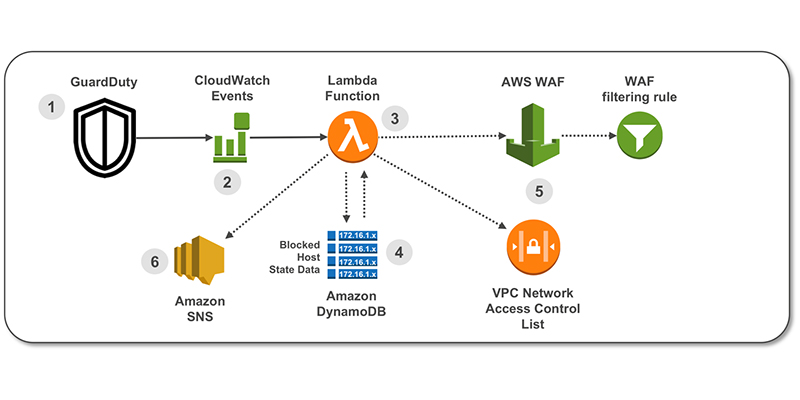
How to use Amazon GuardDuty and AWS Web Application Firewall to automatically block suspicious hosts
April 25, 2023: We’ve updated this blog post to include more security learning resources. When you’re implementing security measures across your AWS resources, you should use a holistic approach that incorporates controls across multiple areas. In the Cloud Adoption Framework (CAF) Security perspective whitepaper, we define these controls across four categories. Directive controls. Establish the […]

Amazon ElastiCache for Redis now PCI DSS compliant, allowing you to process sensitive payment card data in-memory for faster performance
Amazon ElastiCache for Redis has achieved the Payment Card Industry Data Security Standard (PCI DSS). This means that you can now use ElastiCache for Redis for low-latency and high-throughput in-memory processing of sensitive payment card data, such as Customer Cardholder Data (CHD). ElastiCache for Redis is a Redis-compatible, fully-managed, in-memory data store and caching service […]

U.K. National Health Services IGToolkit Assessment report now available
We know that customers often seek out third-party tools to allow for the baselining and benchmarking of their environment. Additionally, healthcare and life sciences customers (HCLS) have specific needs, which is why we continually strive to meet relevant global standards validating our security and compliance. Today, we’d like to take a look at a new […]

Accept a BAA with AWS for all accounts in your organization
I’m excited to announce to our healthcare customers and partners that you can now accept a single AWS Business Associate Addendum (BAA) for all accounts within your organization. Once accepted, all current and future accounts created or added to your organization will immediately be covered by the BAA. Our team is always thinking about how […]

Delegate permission management to developers by using IAM permissions boundaries
Today, AWS released a new IAM feature that makes it easier for you to delegate permissions management to trusted employees. As your organization grows, you might want to allow trusted employees to configure and manage IAM permissions to help your organization scale permission management and move workloads to AWS faster. For example, you might want […]

How to connect to AWS Secrets Manager service within a Virtual Private Cloud
You can now use AWS Secrets Manager with Amazon Virtual Private Cloud (Amazon VPC) endpoints powered by AWS Privatelink and keep traffic between your VPC and Secrets Manager within the AWS network. AWS Secrets Manager is a secrets management service that helps you protect access to your applications, services, and IT resources. This service enables […]

Recovering from a rough Monday morning: An Amazon GuardDuty threat detection and remediation scenario
Amazon GuardDuty is a managed threat detection service that continuously monitors for malicious or unauthorized behavior to help you protect your AWS accounts and workloads. Given the many log types that Amazon GuardDuty analyzes (Amazon Virtual Private Cloud (VPC) Flow Logs, AWS CloudTrail, and DNS logs), you never know what it might discover in your […]

How to access secrets across AWS accounts by attaching resource-based policies
October 29, 2021: AWS KMS is replacing the term customer master key (CMK) with AWS KMS key and KMS key. The concept has not changed. To prevent breaking changes, AWS KMS is keeping some variations of this term. More info. You can use AWS Secrets Manager to rotate, manage, and retrieve secrets such as database […]

Updated data classification whitepaper, includes guidance on establishing data classification programs
Note from March 25, 2020: This post was originally published on June 20, 2018, along with the Secure Cloud Adoption: Data Classification whitepaper, which has now been refreshed with newer information. We’ve updated our post accordingly. We’re sharing an update to the Secure Cloud Adoption: Data Classification whitepaper to help customers address data classification. Data […]